Cleaning & care
How to clean Crocs: foam, lined and fabric styles
Know the material first. An all-foam pair and a lined or fabric style do not necessarily need the same routine.
Read the full guide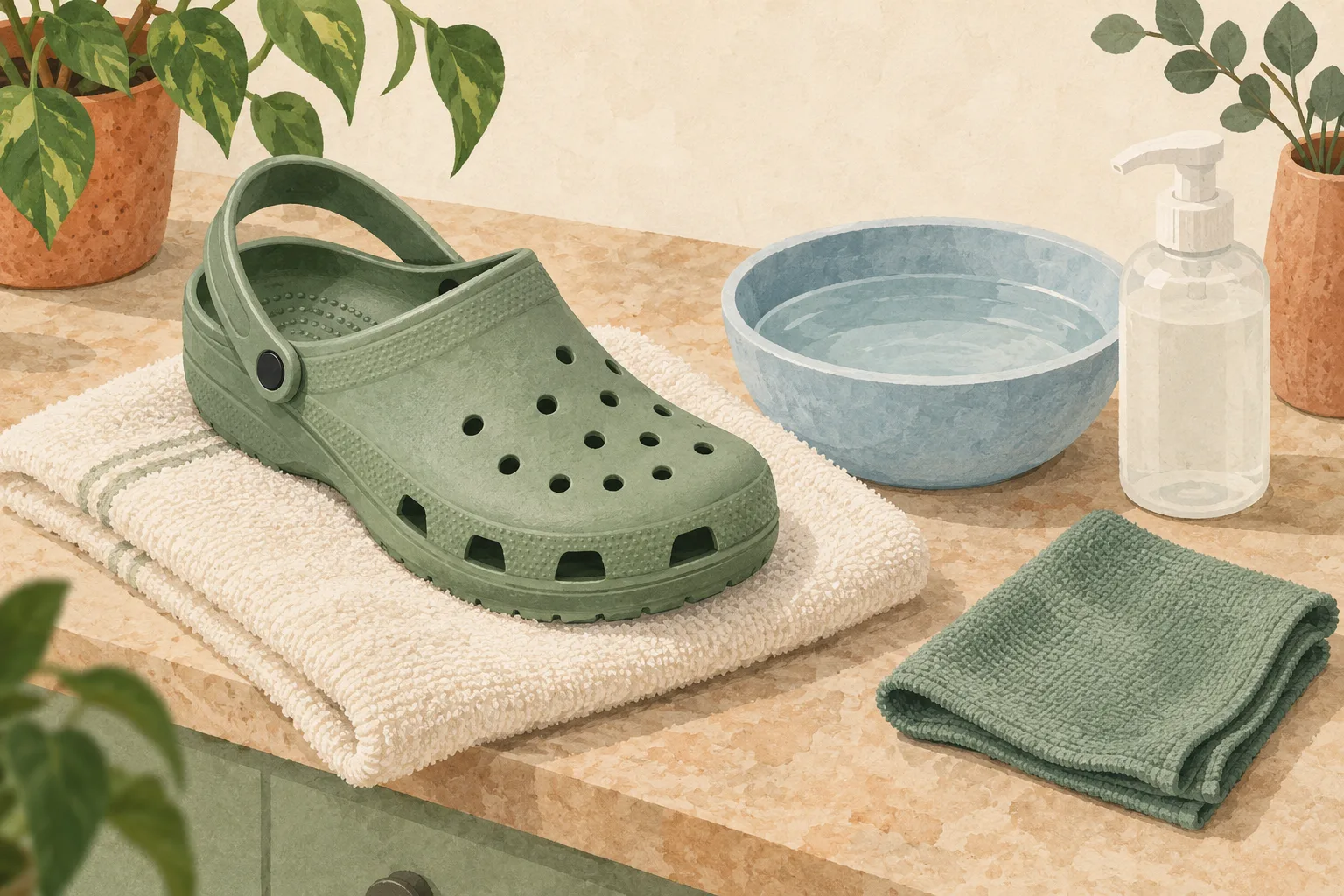
A gentle routine for plain foam
Identify the material
Check the model, lining and trim before choosing a method.
A useful detail
Use the instructions for your particular pair. The plain-foam routine is not a universal method for fleece, fabric, leather or decorated styles.
Clean gently
For entirely Croslite foam, use mild soap and cold water as directed.
A useful detail
Start with a small area and inspect the result. Stop if colour transfers, the finish changes or an attachment loosens.
Air dry away from heat
Allow a separate drying step before wearing or storing the pair.
A useful detail
Keep shoes away from dryers, radiators, hot cars and prolonged intense sunlight. Heat can shrink or distort them; no fixed drying time is promised.
For a pair made entirely from Croslite foam, start with cold water and mild soap, then let the shoes air dry. A lined, fabric or decorated pair needs its own care instructions. The useful first question is not “Can Crocs get wet?” but “What is this particular pair made from?”
Independent guide. CrocsDeal is not affiliated with or endorsed by Crocs, Inc. This guide combines manufacturer references with an original cleaning checklist; it is not a hands-on product test. Crocs and its product names belong to their respective trademark owners.
Choose the method before you start
Find the model name or product code on your order record and compare it with the current product page. Check the whole shoe, including its lining and trim. The table is a starting point, not permission to ignore a care label.
| Your pair | Starting point | Check first |
|---|---|---|
| Entirely Croslite foam | Hand or spot cleaning with mild soap and cold water. | Confirm there is no lining or special finish requiring different care. |
| Fleece-lined | Mild soap on a damp cloth is a manufacturer-listed option. | Do not assume the lining is removable. |
| Canvas, suede, leather or mixed materials | Use the material-specific instructions. | Do not apply the plain-foam routine to every component. |
The foam and fleece options above come from Crocs Canada’s care FAQ. That page separates several material types. If you cannot identify yours, send the product code and a clear photo to the manufacturer before choosing a cleaner.
A manageable routine for plain foam clogs
Use this sequence only after confirming that the pair’s instructions allow the foam-cleaning method. Put a cloth, mild soap and cold water beside a washable work area. Keep the task away from food-preparation surfaces.
- Look before cleaning. Check each shoe for loose parts or damage. If you are asking the seller about a defect, photograph it before changing its appearance.
- Start with one area. Gently remove loose dirt, then work on a small section with the permitted soap-and-water method. Check the result before continuing around the shoe.
- Check the details. Work around the strap and openings without pulling off parts. Remove cleaner residue as directed by the product’s instructions; do not leave visible soap behind.
- Finish with a separate drying step. Put the pair aside to air dry, then inspect the surfaces and attachments again before wearing or storing it.
This order makes it easier to notice a problem early. If colour transfers, a finish changes or an attachment loosens, stop rather than adding more cleaner or pressure. A persistent mark is a reason to ask a specific care question, not proof that stronger treatment will work.
Can Crocs go in the washing machine?
There is no useful blanket “yes” for every pair. The Canadian FAQ lists a gentle machine cycle among its options for entirely Croslite styles. The Crocs UK FAQ is more cautious: it recommends hand washing and places machine washing at the owner’s risk. These regional pages do not give identical advice.
Use the instructions supplied for your model and market. If they are unclear or conflict, ask Crocs before machine washing. This guide favours a permitted hand-cleaning method for an identified plain-foam pair; it does not prescribe a universal temperature, detergent dose or cycle for lined and decorated shoes.
What about a pressure washer?
This guide does not recommend pressure washing: no model-specific safe pressure setting was verified. Being able to wash a shoe does not establish that any cleaning tool is suitable. Choose a method listed for the actual pair instead of guessing a nozzle setting or testing a forceful jet.
Drying and storage: keep heat out of the plan
Crocs’ Canadian guidance calls for air drying and warns that extreme heat, including hot cars, can shrink or distort shoes. Do not use a dryer, radiator or hot-water treatment to speed drying or change the fit. The UK guidance also cautions against prolonged intense sunlight.
Choose somewhere the shoes will not obstruct a walkway. Check the inside as well as the outside before putting them into closed storage. Rather than promising a fixed drying time, plan another pair for your next outing if these are not ready.
When cleaning is not the answer
A scuff, a split strap and loose dirt are different problems. Cleaning is not a repair, an authenticity test or a way to certify remaining service life. For damage, record the location and what you noticed; for fit, use the size and fit checklist instead of trying to reshape the shoe.
Keep a short note containing the model, care-page link, method used and result. For example, “left shoe, mark beside the strap, still visible after the permitted method” gives support a clearer starting point than “cleaning failed.” There is no need to invent a successful result or repeatedly experiment.
For seller or order questions, follow the buying checklist. Browse the Crocs footwear guides for related help, or use Contact to report an error in this guide.
First published 24 September 2026. Substantively updated 13 October 2026 with material selection, a cleaning sequence and regional source comparison. Manufacturer references checked on 13 October 2026. Editorial and source checks were AI-assisted; no human review or hands-on testing is claimed.