Pool lengths and swim distance: metres, yards and counts
Calculate swimming distance from complete pool lengths. Compare 25 m, 50 m and 25-yard pools, convert units, and keep a clear log with worked examples.
On this page
“Twenty lengths” is a useful count only when you know the distance between the walls. Twenty lengths in a 25-metre pool and twenty in a 50-metre pool are different totals. A 25-yard pool introduces another difference: yards and metres are not interchangeable. A clear swim log needs both the count and the unit.
This guide explains the arithmetic for completed pool lengths. The example distances are not workout targets or advice about how far you should swim. For choosing a suitable session and understanding lane etiquette, start with our guide for new lap swimmers.
Confirm the lane distance today
Ask the facility how long the lane is in its current configuration. A venue advertising a 50-metre pool does not necessarily offer a 50-metre swimming route throughout the day. At Adelaide Aquatic Centre, for example, a movable boom allows its indoor competition pool to operate in either 50-metre or 25-metre mode. This illustrates why the session setup matters; check the venue’s current availability rather than relying on an old timetable.
Record the unit as well as the number. “25” on its own could mean 25 metres or 25 yards. If staff confirm a different distance, use that actual lane length in the calculation instead of rounding it to a familiar pool size.
Count complete lengths consistently
For the calculations here, one length means one completed trip from one end of the lane to the other. Travelling there and back is two lengths. If someone gives you a number of “laps,” ask whether they mean individual lengths or return trips before recording a total. Writing “20 lengths of 25 m” removes that ambiguity.
U.S. Masters Swimming’s distance explanation describes 25-yard courses as short course yards, or SCY; 25-metre courses as short course metres, or SCM; and 50-metre courses as long course metres, or LCM. Keep the final letter when copying those abbreviations. A short-course label without its unit leaves useful information out.
Multiply count by length
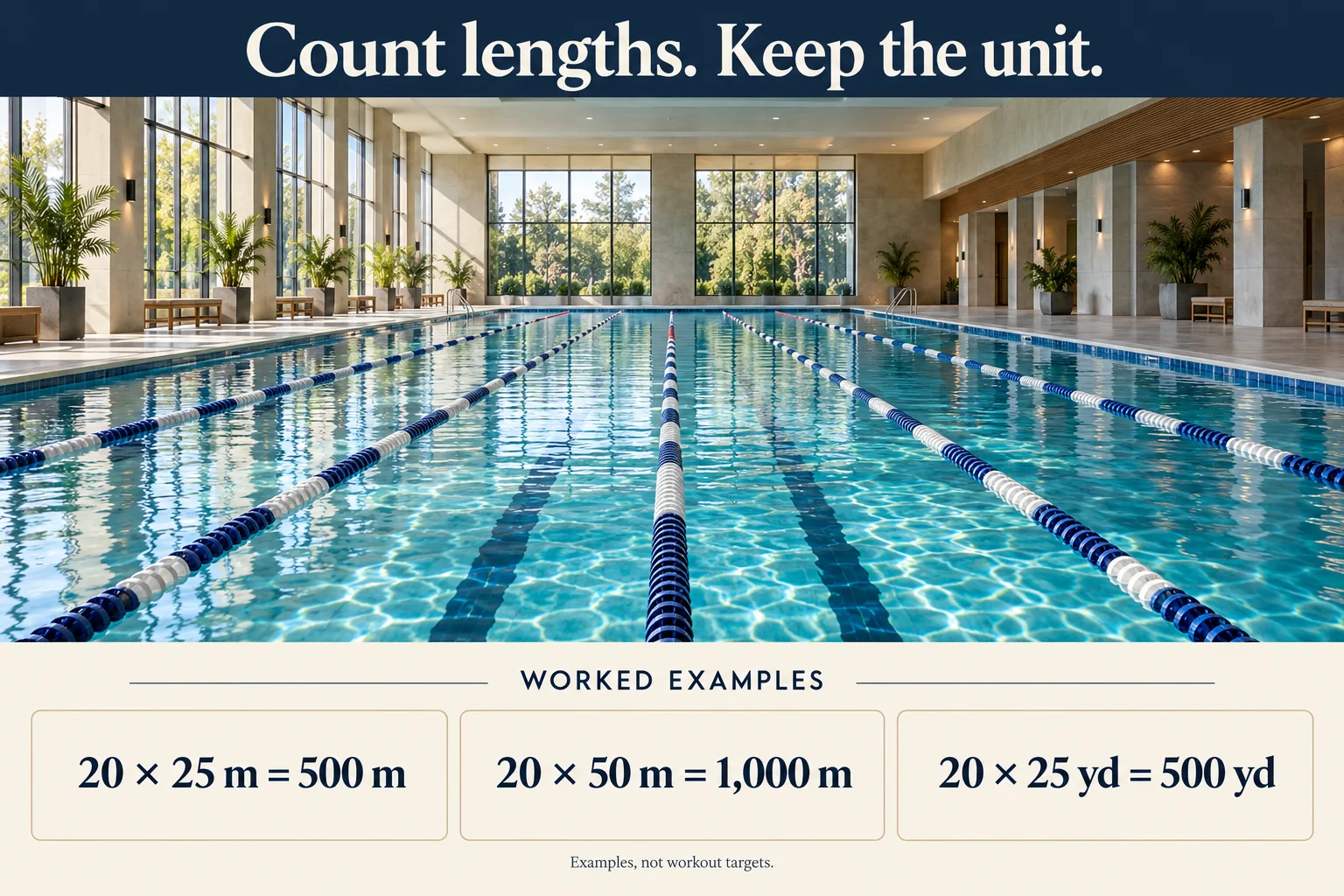
The calculation is: completed lengths × distance per length = total distance. Keep the unit attached through the multiplication. This table deliberately holds the count at twenty so you can see what changes when the pool changes.
| Pool | Count | Total |
|---|---|---|
| 25 m | 20 | 500 m |
| 50 m | 20 | 1,000 m |
| 25 yd | 20 | 500 yd |
You can also divide a distance by the lane length to find its count. As an arithmetic example, 400 metres takes sixteen 25-metre lengths or eight 50-metre lengths. Swim England’s pool-swimming introduction distinguishes these 25-metre short-course and 50-metre long-course formats. Equal distance does not mean an identical swim: the shorter pool requires more changes of direction.
Convert yards without relabelling them
The NIST length reference gives the relationship of one yard to 0.9144 metre. Multiply a yard total by 0.9144 to express that same distance in metres. Thus 500 yards equals 457.2 metres. It does not become 500 metres because both pool signs began with “25.”
The difference between 500 metres and 500 yards is 42.8 metres. This is a unit conversion, not evidence that one swimmer worked harder or performed better. Keep the original yard total in your log and add the conversion alongside it; that preserves what you actually counted.
Make the log easy to check
A compact entry could read: “25 m lane; 12 lengths plus 8 lengths; 20 lengths total; 500 m.” Adding those two blocks before multiplying gives the same result as calculating 300 metres and 200 metres separately. Record rests separately rather than counting them as distance.
If the lane length changes between swims, calculate each block first. Eight lengths of 50 metres plus four lengths of 25 metres totals 500 metres; multiplying all twelve lengths by one pool size would be wrong. Keep uncertain or partial lengths separate rather than inventing a precise total.
Timing labels deserve similar care. Our gun-time and chip-time guide shows why the reference point matters when reading a road-race result. Distance, elapsed time and the conditions of an activity answer different questions.
Practical takeaway
Confirm the lane length and unit, count complete end-to-end trips, and multiply before comparing totals. Preserve yards when that is what you swam; add a clearly labelled metre conversion if useful. A log that states its inputs is easier to check than a bare number of laps.
Sources
- Adelaide Aquatic Centre — lap swimming and pool modes, Adelaide Aquatic Centre
- Masters Swimming 101: Yards and Meters, U.S. Masters Swimming
- An introduction to competitive pool swimming, Swim England
- SI Units — Length, National Institute of Standards and Technology
Continue reading
Related articles

Movement Breaks for Desk-Bound Days
A workout does not erase every long spell of sitting. Small, frequent movement breaks can fit around focused work without requiring equipment or a change of clothes.

Exercising Safely in Hot and Humid Weather
Heat and humidity can turn a familiar workout into a much harder effort. Plan around the conditions, slow the pace and know when the safest decision is to stop.

Recovery Days That Keep a Fitness Habit Moving
Recovery is not an empty space between “real” workouts. A well-planned easier day can support sleep, restore enthusiasm and make the next session easier to approach.