Athletics Throwing Events: Shot Put, Discus, Hammer and Javelin
The standard English term is “throwing events.” Learn how shot put, discus, hammer and javelin differ in equipment, competition area and what makes an attempt valid.
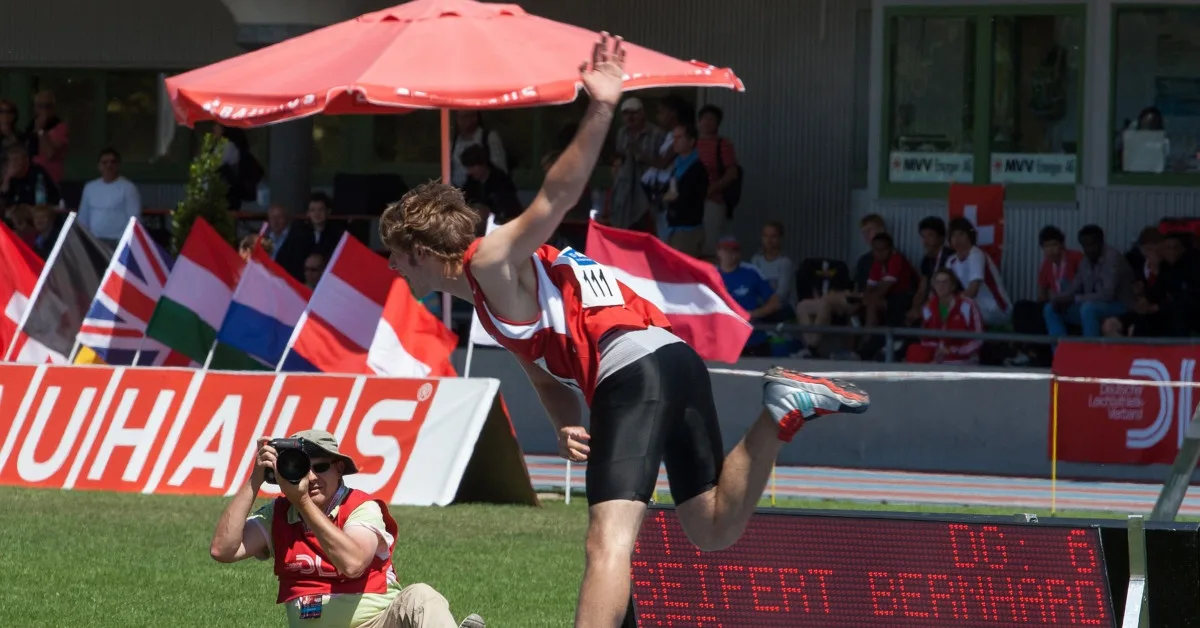
“Launch tests” is a literal translation that sounds unnatural in English. In athletics, the established name is throwing events. The stadium programme has four: shot put, discus, hammer and javelin. Each asks an athlete to send an implement as far as possible, but the implements and legal movements are very different.
Throwing should take place only in a properly marked, supervised facility. Discus and hammer require protective cages, and every event needs a landing sector kept clear. This overview helps a spectator recognise the events; it is not a substitute for coaching or facility safety procedures.
Shot put
The shot is a solid metal sphere. It is “put,” not pitched like a baseball: the athlete holds it close to the neck and pushes it from the shoulder with one hand. The official World Athletics shot-put guide describes a 2.135m circle with a stop board at the front. The athlete may glide or rotate to build force while staying within the circle.
A valid put must land inside the marked sector. The athlete cannot touch the top of the stop board or the ground outside the circle during the attempt, and must wait for the shot to land before leaving correctly through the rear half. Implement weights vary by sex and age category, so the specification for one division should not be presented as universal.
Discus throw
The discus is a weighted circular implement. The athlete turns inside a 2.5m circle and releases it toward the sector through the cage opening. World Athletics’ discus overview explains that the nearest mark made by the landing implement is used for measurement.
Balance and timing matter because a fast rotation must still finish under control. Stepping outside before the discus lands, touching the top of the circle rim or landing outside the sector makes the attempt a foul. Wind can change the flight, which is one reason two throws with similar release effort may not travel identically.
Hammer throw
The athletics hammer is not a tool from a workshop. It consists of a metal head connected by wire to a handle. The thrower turns inside a 2.135m circle, building speed before releasing through a protective cage. The official hammer guide sets out the implement’s parts and the circle, cage and sector basics.
Because the hammer travels quickly on a wide orbit, cage configuration and an empty landing area are essential. Spectators and untrained participants should never enter a throwing zone or improvise an implement. A legal throw also requires the athlete to remain within the circle and leave only after the hammer has landed.
Javelin throw
Javelin differs from the circle events. The athlete runs along a runway and throws a spear-shaped implement over the shoulder. The tip must strike the ground before any other part for a valid mark; the implement does not have to remain stuck upright. The throw must land within the sector, and the athlete cannot cross the arc at the end of the runway.
The official World Athletics javelin overview records that the senior men’s and women’s implements use different specifications and that younger categories may use other weights. Javelin design has also changed over time, so historical record lists must be read in the context of the specification then in use.
Attempts, measurements and results
Competition usually gives each athlete an initial set of attempts, with additional attempts for leading qualifiers under the meeting format. The longest valid result decides the placing; a throw that is farther but foul does not count. Ties are resolved using next-best valid performances rather than an athlete’s reputation or earlier ranking.
Exact time limits, implement certifications, trial order and qualification procedures come from the applicable rule book. World Athletics maintains a current technical-information library because amendments can make an old summary incomplete.
Practical takeaway
Remember the defining action and space: put a shot from a circle; spin and throw a discus from a larger circle; turn a wire-handled hammer inside a cage; run up and throw a javelin before the arc. In every case, a clear sector, trained supervision and the current competition rules matter more than copying a technique from a short video.
Sources
- Shot Put, World Athletics
- Discus Throw, World Athletics
- Hammer Throw, World Athletics
- Javelin Throw, World Athletics
- Technical Information, World Athletics
Continue reading
Related articles

What Is Athletics? A Beginner’s Guide to Track, Field and Road Events
Athletics is more than track racing. Its programme includes jumps, throws, combined events, race walking and running on roads and natural terrain under shared competition rules.

Long-Distance Athletics: Track, Road and Cross-Country Events Explained
The phrase “background tests” is a translation error. Long-distance athletics includes track races, road events and cross country, each with its own course, rules and racing demands.
Middle-Distance Track Events: 800m, 1500m and 3000m Explained
Middle-distance racing sits between sprinting and long-distance events, combining pace, positioning and endurance. Learn how the 800m, 1500m and related track races are organised.