What Is Athletics? A Beginner’s Guide to Track, Field and Road Events
Athletics is more than track racing. Its programme includes jumps, throws, combined events, race walking and running on roads and natural terrain under shared competition rules.

Athletics is the organised sport of running, race walking, jumping and throwing. “Track and field” describes much of the stadium programme, but athletics reaches beyond the stadium to road races, cross country, mountain and trail running. The common thread is that performances are measured by time, distance, height, points or finishing position under agreed rules.
World Athletics describes the sport’s foundation as the human ability to run, jump, throw and walk. Its organisation overview also explains why an international federation was created in 1912: competitions and records need shared standards if results from different places are to mean the same thing.
Track events
Track races range from explosive sprints to long-distance events. The familiar outdoor lap is 400m, although indoor tracks are commonly shorter. Sprints include the 100m, 200m and 400m. Hurdle races place barriers in each lane, and relays require teams to transfer a baton within defined zones.
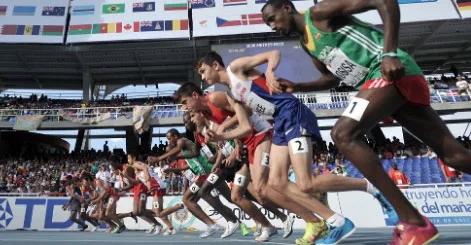
Middle- and long-distance events include the 800m, 1500m, 5000m and 10,000m. The 3000m steeplechase combines distance running with fixed barriers and water jumps. Starts, lane use and qualification formats differ, so “first across the line” is only part of the rule story.
Jumps
The horizontal jumps are the long jump and triple jump. Athletes run along a runway, take off without crossing the foul line and land in a sand pit. Distance is measured from the take-off line to the nearest mark made in the landing area. Triple jump adds the required hop, step and jump sequence.
The high jump and pole vault are vertical jumps. Competitors try to clear a crossbar as its height increases. Three consecutive failures normally end an athlete’s competition, although athletes can pass attempts. Pole vault adds a flexible pole, a planting box and specialised safety equipment, making supervised facilities essential.
Throws
The four standard throwing events are shot put, discus, hammer and javelin. In the shot put, the implement is pushed from the shoulder rather than thrown like a ball. Discus and hammer use a throwing circle and protective cage; javelin uses a runway. A valid implement must land inside its sector, and the athlete must complete the attempt without fouling.
Implement weights vary by competition category. A casual object is not a safe substitute for certified throwing equipment, and throwing areas must be controlled so nobody enters the landing sector.
Combined events
The decathlon and heptathlon combine performances across track and field disciplines. Athletes earn points from result tables rather than simply counting event wins. Success therefore rewards breadth: sprinting, jumping, throwing and endurance all contribute to the total.
Beyond the stadium
Road running includes events such as 5km, 10km, the half marathon and marathon. Race walking has its own technical definition and judging. Cross country uses natural terrain, while mountain, trail and ultra running extend athletics into different distances and environments. The official World Athletics discipline directory shows how broad the programme has become.
How competition is organised
A meeting timetable may include heats, qualification rounds and finals. Officials manage starts, measurements, attempts, results and rule compliance. Age group, venue and competition level affect hurdles, implement weights, available events and advancement. Para athletics also adapts classifications, equipment and event rules to support fair competition across eligible impairments.
Rules change over time. The governing body’s technical-information library publishes current competition rules, amendments, facility manuals and guidance. A general article can explain the shape of the sport; an athlete, coach or official should use the rule edition named by the actual competition.
Ways to take part
Participation can begin with a local club, school, community running group or organised road event. Beginners do not need to choose a permanent “event” immediately. Trying age-appropriate, properly supervised activities can reveal whether the appeal is speed, endurance, jumping, throwing, officiating or simply being part of a meet.
Practical takeaway
Use athletics as the umbrella term. Under it, place track races, field jumps and throws, combined events, race walking, road running and off-road disciplines. When a detail affects competition—distance, lane break, implement, attempt or qualification—check the organiser’s current rule book rather than relying on a generic summary.
Sources
- Organisation, World Athletics
- Our Sport, World Athletics
- Technical Information, World Athletics
Continue reading
Related articles

Long-Distance Athletics: Track, Road and Cross-Country Events Explained
The phrase “background tests” is a translation error. Long-distance athletics includes track races, road events and cross country, each with its own course, rules and racing demands.

Athletics Throwing Events: Shot Put, Discus, Hammer and Javelin
The standard English term is “throwing events.” Learn how shot put, discus, hammer and javelin differ in equipment, competition area and what makes an attempt valid.
Middle-Distance Track Events: 800m, 1500m and 3000m Explained
Middle-distance racing sits between sprinting and long-distance events, combining pace, positioning and endurance. Learn how the 800m, 1500m and related track races are organised.