Long-Distance Athletics: Track, Road and Cross-Country Events Explained
The phrase “background tests” is a translation error. Long-distance athletics includes track races, road events and cross country, each with its own course, rules and racing demands.

“Background tests” is not a standard athletics term; it appears to be a poor translation of long-distance events. In athletics, distance running spans several environments. Some races circle a measured track, some follow a certified road course, and others cross grass, mud or hills. They share an emphasis on sustained running, but their formats should not be blurred together.
The official World Athletics discipline list separates middle/long track events from road running, cross country, mountain and trail running, and ultra running. That structure is a useful starting point. It explains why a 10,000m track race and a 10km road race cover the same nominal distance but are recorded as different events.
Long-distance races on the track
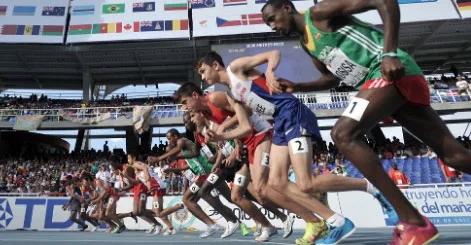
The best-known championship track distances are the 5000m and 10,000m. On a standard outdoor 400m track, the 5000m is twelve and a half laps. The official 5000m overview describes a group start and a finishing order determined at the line. Major competitions may use heats before a final, depending on the number of entrants and the rules.
The 10,000m covers 25 laps. World Athletics’ 10,000m event guide distinguishes it from the road 10km and notes that major championships commonly stage it as a straight final. Athletes do not remain in separate lanes for the race. They negotiate shared space, changes in pace and the practical challenge of keeping count through many laps.
Track racing creates exact intermediate splits and a level, repeated circuit, but that does not make every race predictable. A field may pursue a fast time, settle into a controlled championship pace or change speed sharply. Running close to the inside saves distance; moving outside can provide room to pass. Legal positioning and awareness matter alongside endurance.
Road races use measured courses
Common road distances include 5km, 10km, the half marathon and the marathon. The marathon is 42.195km. Unlike the repeated geometry of a track, a road course can include turns, changes in elevation and varying exposure to weather. Certified course measurement and event rules determine whether performances are eligible for official purposes.
Road events may involve mass participation as well as elite competition. Start waves, timing mats, aid stations, cutoff times and traffic arrangements are event-specific. A first-time participant should use the organiser’s instructions, not assumptions borrowed from a televised championship.
Cross country leaves the road
Cross-country races take place on natural terrain. Course length and conditions can vary, and grass, soft ground, turns and hills make direct time comparisons less meaningful than on a track. Team scoring is also a major feature at many school, club and championship meetings.
Mountain, trail and ultra running extend the family further. Those labels describe distinct formats with their own governance, terrain, distances and safety requirements. “Long distance” is therefore a broad description, not a promise that every event uses the same equipment or preparation.
Distances, units and names
Track events are normally named in metres: 5000m and 10,000m. Road events are commonly styled in kilometres: 5km and 10km. A “5K” road event and a 5000m track race are both five kilometres long, but the venue and record category differ. The same distinction applies to 10km and 10,000m.
Age-group and local programmes may offer shorter or different distances. Indoor tracks also have different lap counts because the circuit is usually shorter. Always read the entry information and current rules for the actual meeting.
Practical takeaway
Replace the confusing phrase “background tests” with “long-distance events.” First identify the setting: track, road or natural terrain. Then name the exact race—such as 5000m, 10,000m, 10km, marathon or cross country. That simple habit makes results, lap counts, course conditions and rules much easier to understand.
Sources
- Our Sport, World Athletics
- 5000 Metres, World Athletics
- 10,000 Metres, World Athletics
Continue reading
Related articles
Middle-Distance Track Events: 800m, 1500m and 3000m Explained
Middle-distance racing sits between sprinting and long-distance events, combining pace, positioning and endurance. Learn how the 800m, 1500m and related track races are organised.

What Is Athletics? A Beginner’s Guide to Track, Field and Road Events
Athletics is more than track racing. Its programme includes jumps, throws, combined events, race walking and running on roads and natural terrain under shared competition rules.

Athletics Throwing Events: Shot Put, Discus, Hammer and Javelin
The standard English term is “throwing events.” Learn how shot put, discus, hammer and javelin differ in equipment, competition area and what makes an attempt valid.