Badminton racket labels: 3U, 4U and G5 explained
Understand badminton racket U and G labels, average frame weights, grip options and stringing-advice rows using specific Yonex and Mizuno examples.
On this page
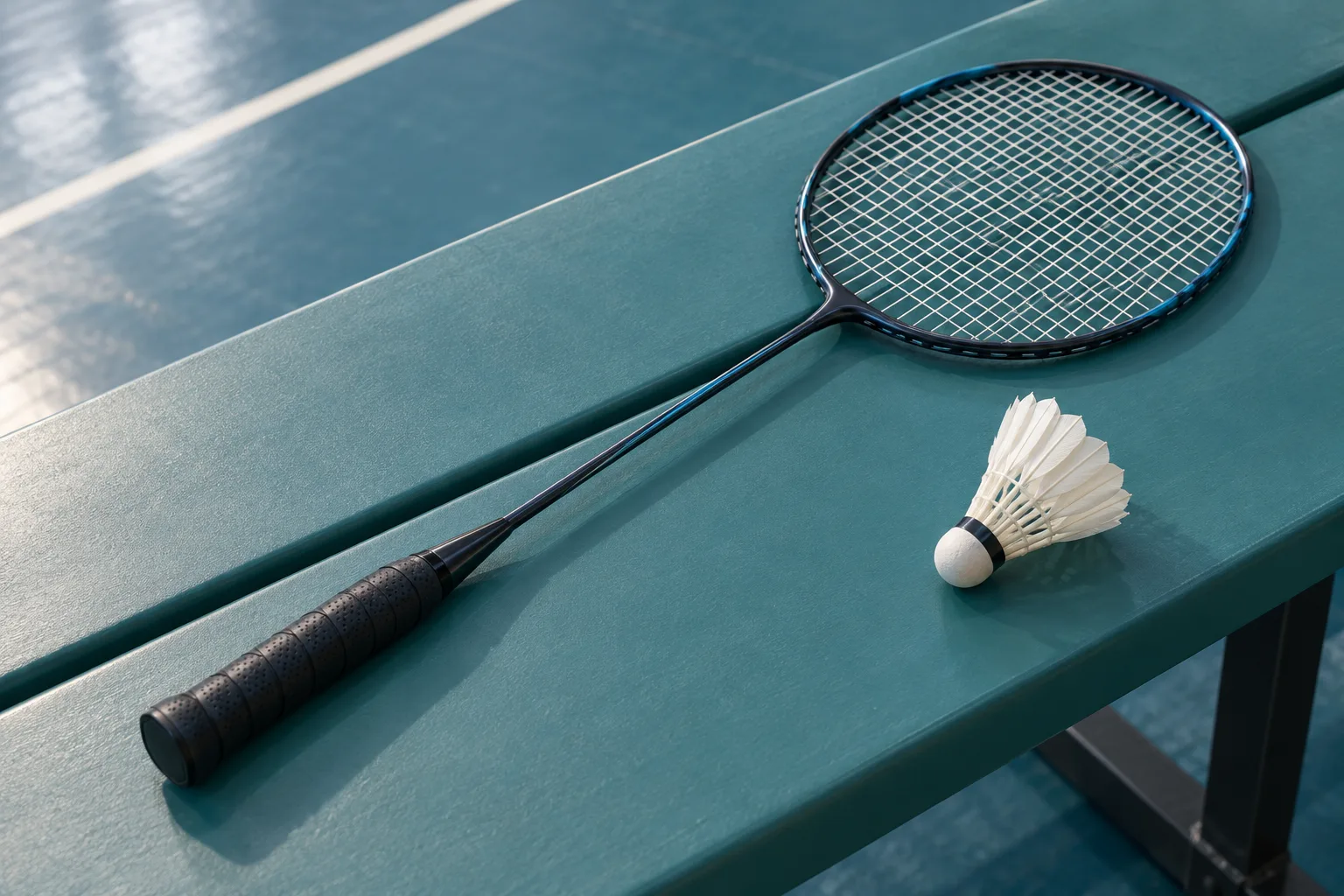
A badminton racket marked 4U G5 carries two separate specifications: a weight class and a grip-size code. Read the letters with the numbers. Neither “4” nor “5” is a score for quality, and the combined label is not a measurement in grams.
This guide uses named manufacturer examples to explain the codes and how to compare variants. It does not select a racket for your body or playing level, report a hands-on test, or promise better shots or fewer injuries.
Separate the U field from the G field
The Yonex Japan FAQ lists 3U at an average frame weight of 88 g and 4U at an average of 83 g. Its answer covers the company's recent badminton rackets approved by the Japan Badminton Association. In those examples, the higher U number describes the lighter class.
The same answer orders grip sizes from thinner to thicker as G7, G6, G5 and G4. Thus G6 is thinner than G5 within that stated system. This is a handle-size distinction, not another weight category. Keep the manufacturer and model beside the code instead of assuming every brand or older racket uses an identical scheme.
Our tennis grip-size guide explains a different numbered system. A tennis size 4 and a badminton G4 should not be treated as interchangeable merely because both contain a four.
An average and a range answer different questions
Yonex's 83 g figure is explicitly an average. It does not promise that every individual 4U racket will give exactly 83 g on a scale. Nor does the FAQ turn that number into the weight of a completed setup with unspecified strings and accessories.
For comparison, Mizuno's Japanese support chart describes badminton frame-weight bands: 4U is at least 80 g but below 85 g; 3U is at least 85 g but below 90 g. The upper boundary is excluded. Those are Mizuno's published bands, not a tolerance calculated from Yonex's average.
When recording a shop measurement, note what was weighed. A bare frame specification and a reading from an equipped racket are not automatically comparable. If the source does not explain the configuration, leave that detail unresolved rather than subtracting a guessed weight for strings or wrapping.
Read the available combinations row by row
The ASTROX 88 S PRO listing, item 3AX88S-P, provides a concrete example. Its specification rows pair the weight classes with different grip options:
| Weight class | Listed average | Grip options |
|---|---|---|
| 4U | 83 g | G5, G6 |
| 3U | 88 g | G4, G5, G6 |
Comparing 3U G5 with 4U G5 holds the printed grip code constant while changing the weight class. Comparing 4U G5 with 4U G6 holds the weight class constant while changing the grip code. Comparing 3U G5 with 4U G6 changes both. These are comparisons of listed specifications, not claims that two physical rackets will otherwise feel identical.
A manufacturer's listed combination also does not establish current stock at your local shop. Match the exact model, generation and selected variant before ordering.
Keep stringing advice in its own column
The same product page gives different stringing-advice rows: 20–28 lb for 4U and 21–29 lb for 3U. These figures concern stringing tension, not racket mass. They are model-specific guidance, not a recommendation to choose the upper number or instructions for stringing a racket yourself.
Keep the relevant weight-class row with the full model name when asking a stringer about the manufacturer's instructions. Do not transfer one model's range to another because both have a 4U label.
Make a useful comparison note
Write down the model and generation, U code, G code, stated weight basis and any uncertainty about the actual setup. For a used racket, distinguish the original printed specification from what is currently fitted. Ask about unclear fields before assuming the seller's shorthand describes everything.
Weight class alone does not provide a balance point or a swingweight measurement. Our weight, balance and swingweight explanation separates those concepts using tennis examples; it does not supply badminton specifications.
Practical takeaway
The useful outcome is a complete description, not a universal winning code. Decode both fields, compare one change at a time and use the exact model's documentation for the remaining questions.
Sources
Continue reading
Related articles
Where are Crocs made? Country labels and shipping origins
Separate Crocs country markings from parcel dispatch locations. Read the 2025 sourcing figures carefully and check what they can tell you about a particular pair.

Football or futsal ball? Check more than size 4
Compare football and futsal ball requirements, including circumference, weight and rebound. Check the game and league before buying a ball marked size 4.
When did Crocs buy Jibbitz? The 2006 timeline
Follow Jibbitz's family origins and the 2006 Crocs acquisition. Separate the agreement, closing and announcements, with carefully labelled purchase figures.