Drying wet running shoes: insoles, airflow and heat
Dry running shoes with care: check removable insoles, compare manufacturer paper-fill advice, avoid direct heat and inspect each part before reassembly.
On this page
A dry-looking toe does not tell you whether the inside of a running shoe is ready to wear. After rain or cleaning, treat the shoe, removable insole and any removed laces as separate items to check. The aim is a sensible drying setup, not a race to meet an invented overnight deadline. Start with the care instructions for your exact model and materials.
Identify the parts before taking anything apart
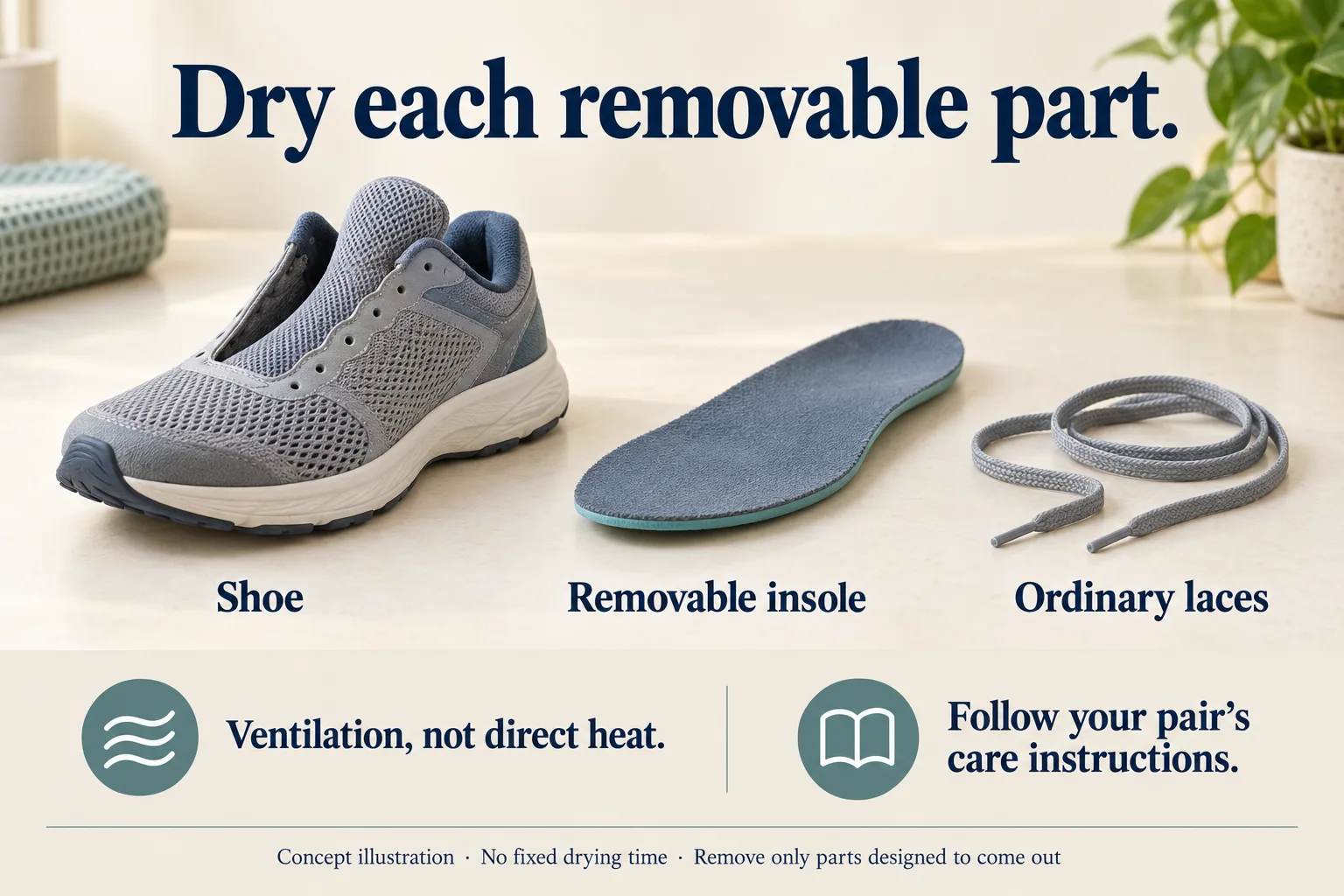
ASICS’ UK care guide recommends drying insoles separately and waiting until the entire shoe is dry before putting them back. That is useful for a removable insole. It does not mean you should pull out a glued liner or dismantle a fastening system that is not designed for routine removal.
Loosen ordinary laces enough to open the shoe comfortably. If you remove them, keep each pair with its shoes and note the threading route first. For a cord-and-toggle or dial closure, use that system’s instructions instead of treating it like an ordinary lace.
Check material-specific guidance before adding any cleaning step. Leather, suede, coatings and membranes can need different treatment. A foam clog is another construction again; our Crocs care guide handles those distinctions separately.
Use absorbent material as directed
ASICS suggests putting tissue or paper towels inside to absorb water for several minutes, then removing them and continuing to air dry. Brooks’ care instructions instead describe placing a dry washcloth or paper towels inside while the shoes air dry. Both are manufacturer examples; they do not establish one mandatory filling method or removal schedule for every shoe.
Follow the method suitable for your pair, and keep the absorbent material separate from anything you intend to refit. Before reassembly, check that no paper or cloth remains inside. Do not add a chemical soak, deodorising mixture or disinfectant merely because the shoes are wet. Drying and cleaning are different tasks, and this guide does not prescribe a cleaning solution.
Choose ventilation, not direct heat
Salomon’s running-shoe guidance calls for a ventilated room at room temperature, away from direct sunlight and radiators. Choose a stable spot where the shoes and loose parts will not obstruct a walkway. Take them out of the closed sports bag rather than using the bag as the drying location.
A tumble dryer is not a shortcut supported by these references. ASICS warns that drying heat can damage the glue joining shoe components; Brooks warns about damage to fabric and foam. Those warnings are reasons to follow the permitted method, not predictions that every exposed shoe will fail in the same way.
Check the components before reassembly
Use this checklist when you think drying is finished. It is a practical inspection aid, not a laboratory moisture test or a guarantee about the shoe’s condition.
| Part | Check | Next step |
|---|---|---|
| Shoe | Interior still damp? | Continue permitted drying |
| Insole | Removable part dry? | Refit only when ready |
| Laces | Removed pair dry? | Refit as instructed |
Keep left and right components with the correct shoe. Refit them without forcing or folding an insole into place. If a part now looks distorted, a bond has opened or the intended position is unclear, ask the manufacturer about that specific change rather than trying to fix it with more heat.
Plan around condition, not the clock
Imagine a pair left to dry after an evening shower. In the morning the upper feels dry, but the removed insole still feels damp. The elapsed night is not evidence that every component is ready. Continue drying as directed and plan another suitable pair if you need to leave; this is an illustrative decision, not a measured drying-time experiment.
Once everything is dry, avoid sealing the shoes away while dampness remains unnoticed inside. Salomon recommends dry, ventilated storage rather than a sealed box or plastic bag. Clothing has its own drying instructions; the sportswear laundry guide covers that separate job.
Practical takeaway
Identify what can safely come out, use the permitted absorbent method, allow ventilation away from direct heat and check every component before refitting. Let the actual condition and the product’s instructions decide when the pair is ready, rather than promising a fixed number of hours.
Sources
- Running shoe cleaning and maintenance, ASICS
- What is the best way to clean my shoes?, Brooks Running
- How to clean your running shoes, Salomon
Continue reading
Related articles

Down-jacket labels: fill power, fill weight and total weight
Read down-jacket fill power, fill weight and total weight separately, using a current Rab example and a fictional comparison without inventing warmth ratings.

Shoe weight: per shoe, per pair and reference size
Compare shoe-weight labels without mixing pairs, single shoes or reference sizes. Read three manufacturer examples and work through simple fictional totals.
Rain-jacket 2L and 3L labels: what the layers mean
Understand bonded layers in rain jackets, read a 3L product example, and keep lining, insulation and DWR separate when comparing shell specifications.