Your First Full-Body Strength Routine at Home
You can learn the foundations of strength training with a chair, a wall and a few controlled movements. This beginner framework focuses on consistency, technique and gradual progress.
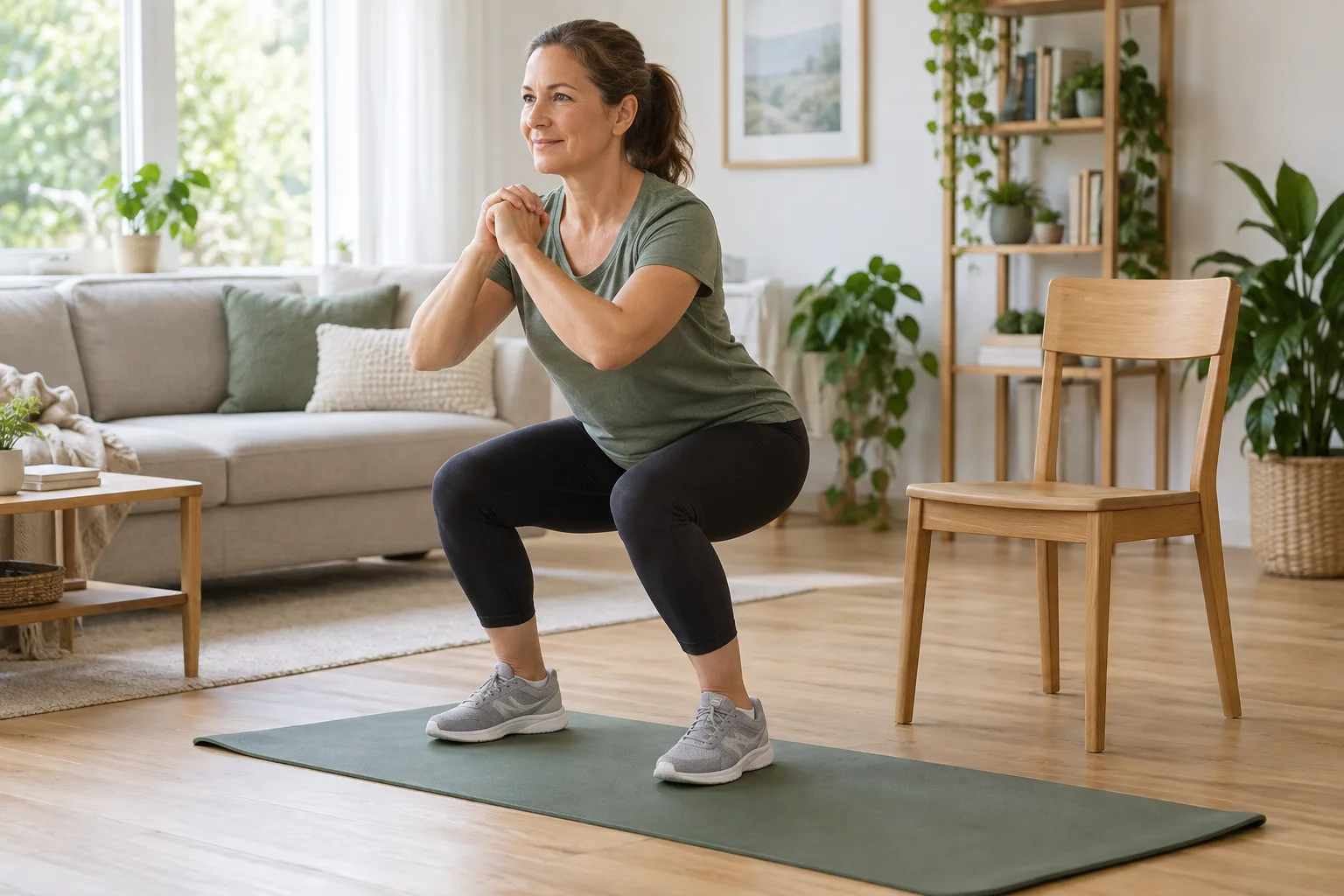
Home strength training can look surprisingly ordinary. Standing up from a chair, pushing away from a wall and carrying a bag all ask muscles to work against resistance. A beginner routine simply organises those patterns so you can practise them with attention and repeat them over time.
The NHS strength and flexibility guidance defines strength activity as work that makes muscles work harder than usual. It recommends involving the major muscle groups on at least two days a week and building up gradually. You do not need an elaborate home gym to begin.
Set up a safe practice space
Clear enough floor space to move without catching a rug or furniture. Use a stable chair that will not roll, and place it against a wall if needed. Wear clothing that lets you move and shoes that feel secure, or train barefoot only if the surface and exercise are suitable.
Before adding resistance, rehearse each movement slowly. A controlled range that feels stable is more useful than forcing a deeper or larger movement. Keep breathing rather than holding your breath. If a movement causes pain, dizziness or unusual symptoms, stop.
Cover the main movement patterns
This sample circuit uses common household support. It is a framework, not a personalised prescription:
- Chair stand: sit near the front of a stable chair, place your feet comfortably, stand with control and sit down softly. Use your hands for support if necessary.
- Wall push: place your hands on a wall, step back, bend your elbows to bring your body closer, then press away while keeping a comfortable straight line.
- Supported hip hinge: hold the chair lightly, soften your knees and move your hips back while keeping your back long, then stand tall.
- Bag row: hold a light bag in one hand, support the other hand on the chair and draw the bag toward your side without twisting. Repeat on the other side.
- Calf raise: hold the chair, rise onto the balls of your feet and lower slowly.
- Low carry: hold a light, evenly packed bag and walk through a clear space with an upright, comfortable posture. Change hands halfway.
These movements include a squat pattern, a push, a hinge, a pull, lower-leg work and carrying. If you cannot perform one comfortably, leave it out and seek qualified guidance rather than improvising through pain.
Choose a starting amount
Begin with one circuit. Use a small number of smooth repetitions that leaves you confident you could do a few more. Rest whenever your technique starts to change. The NHS describes eight to twelve repetitions as a common set range, but a beginner may need fewer while learning. Quality and comfort come first.
Two non-consecutive sessions in a week is a practical starting rhythm. The Move Your Way planner also places muscle-strengthening activity on at least two days within a balanced week. Keep walking or other aerobic activity in the plan too; strength sessions do not need to replace all other movement.
Progress without rushing
Stay with the same version until the movements feel familiar. Then change one detail:
- add one or two repetitions while maintaining control;
- complete a second circuit after a rest;
- use a slightly more challenging angle for the wall push;
- add a small amount of weight to the bag;
- slow the lowering part of a movement.
A heavier object is not automatically better. Household containers can shift, leak or be awkward to grip, so inspect anything you plan to lift. Never use unstable furniture as support.
Keep a useful training note
After each session, record the exercise variation, repetitions and a brief note such as “steady,” “too awkward” or “ready to repeat.” This is enough to show progress and prevent random jumps. If your final repetitions stay smooth for several sessions, a small progression may be reasonable.
Normal effort and temporary muscle tiredness are different from sharp pain, chest discomfort, faintness or symptoms that persist. Stop and seek appropriate medical help when symptoms are concerning. Ask a qualified professional for individual guidance if you have an injury, a health condition or uncertainty about suitable exercises.
Practical takeaway
Choose four to six comfortable movements, complete one controlled circuit and repeat it on two separated days next week. Write down what you actually did. Once the routine feels familiar, progress one small feature instead of rebuilding the whole workout.
Sources
- How to improve your strength and flexibility, National Health Service
- Activity Planner — Move Your Way, U.S. Office of Disease Prevention and Health Promotion
Continue reading
Related articles

A Practical Walking Plan You Can Actually Keep
A useful walking routine does not need an impressive step count or a punishing pace. Start with the time and energy you have, then build a week that is easy to repeat.

A Gentle Mobility Routine for Stiff Days
A short mobility break can help you explore comfortable movement without turning the session into a performance. Use this calm sequence after sitting or whenever your body wants a reset.

Exercising Safely in Hot and Humid Weather
Heat and humidity can turn a familiar workout into a much harder effort. Plan around the conditions, slow the pace and know when the safest decision is to stop.