Tennis scores: sets, tiebreaks and bracketed results
Read tennis set scores, tiebreak points and bracketed results. Use worked examples to distinguish a set tiebreak from one that replaces the deciding set.
On this page
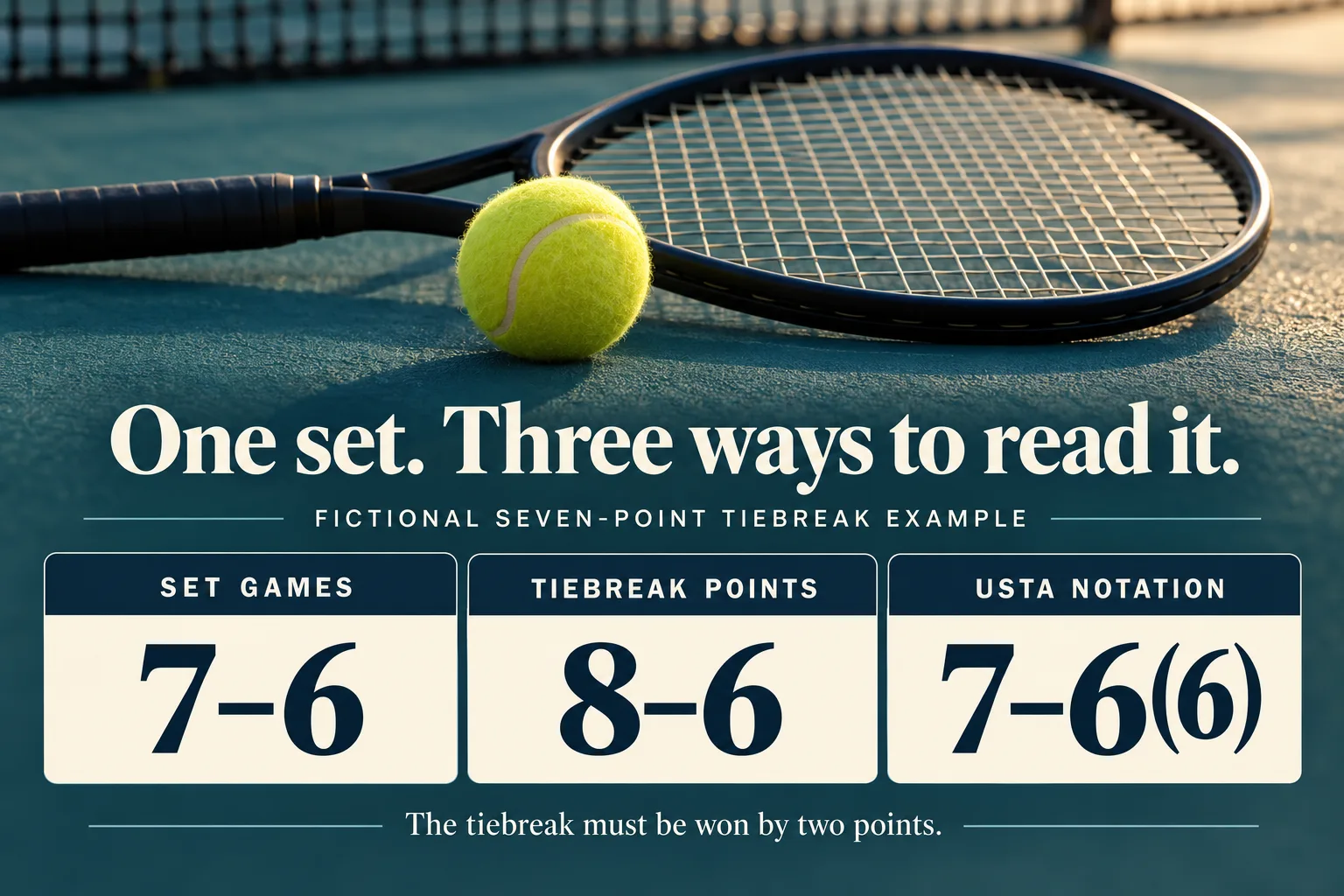
A tennis result can show 7–6 for a set and 8–6 for its tiebreak without contradicting itself. One number describes games in the set; the other describes points in the deciding game. Parentheses and square brackets can add another layer, especially when a tiebreak replaces the final set.
This guide explains completed scores, with fictional examples rather than live results. It uses ordinary tiebreak sets and seven-point set tiebreaks unless stated otherwise. Check the competition’s format before applying an example: not every match uses the same scoring arrangement.
Start with points, games and sets
The LTA’s scoring introduction separates points, games, sets and matches. In a standard game, love, 15, 30 and 40 are point-score labels. They are not the number of games a player has won. A completed set score such as 6–4 records games instead.
For an ordinary best-of-three-sets match, a player needs two sets; best of five requires three. Read the set columns one at a time. Adding every game into one grand total does not determine the match winner.
Why a set can finish 7–6
In the tiebreak-set format described by USTA Officiating, six games each triggers a tiebreak. The winner takes the set 7–6. That set score does not reveal whether the tiebreak itself was close.
A seven-point set tiebreak requires at least seven points and a lead of two. At 7–6 in tiebreak points, play continues. If the leader takes the next point, 8–6 completes it; if the opponent wins that point, 7–7 still needs resolving. The word “seven” is a threshold, not a limit on the number of points played.
Keep the units attached when explaining a result: “7–6 in games, after an 8–6 tiebreak.” This makes the two levels clear without relying on a scoreboard’s layout.
Read the number in parentheses
The notation in USTA’s 2026 Friend at Court, section I.E.1, puts the tiebreak loser’s points in parentheses beside the set score. Thus 7–6(3) indicates a set won through a 7–3 tiebreak. In 7–6(8), the loser reached eight points, so a completed seven-point tiebreak ended 10–8.
The parenthetical number belongs to the tiebreak loser even when the set is written from the other player’s perspective. A 6–7(8) set therefore records a loss through an 8–10 tiebreak. It does not mean eight extra games were played.
| Written | Level | Meaning |
|---|---|---|
| 7–6(3) | Set | Won tiebreak 7–3 |
| 7–6(8) | Set | Won tiebreak 10–8 |
| [10–7] | Match tiebreak | Won 10–7 in points |
Distinguish the two ten-point situations
Appendix VI of the 2026 Rules of Tennis describes a ten-point match tiebreak that replaces the deciding final set. With that format, players do not first play the final set to six games each. After the earlier sets leave the match level, the match tiebreak settles it.
The same appendix separately describes a ten-point final-set tiebreak played after the deciding set reaches 6–6. Both require a two-point margin, but they begin at different stages. A ten-point target alone does not tell you which procedure is in use.
USTA’s recording convention allows square brackets around the points of a match tiebreak replacing the final set. The [10–7] example above is therefore a point score, not a set containing seventeen games. It also allows a 1–0(x) form; follow the actual results system’s explanation.
Keep one player’s perspective throughout
Imagine Player A’s completed result is 6–4, 3–6, 7–6(5). Player A won the first set, lost the second and won the third, taking the match two sets to one. Under the seven-point format used here, the last tiebreak was 7–5. These are invented scores, not a named athlete’s performance.
Now compare 6–4, 3–6, [10–7]. With a ten-point match tiebreak specified, the first two sets are level and Player A wins the deciding tiebreak. Do not rewrite the bracketed entry as another ordinary set score.
Check the player order, format and any score legend before copying a result. Our gun-time and chip-time guide addresses the same reading habit in another sport: identify what a number measures before comparing it.
Practical takeaway
Separate games from tiebreak points, read the notation and identify the deciding format. If a display uses unfamiliar symbols, consult its legend or the organiser rather than guessing. Find more event explainers in Sports & Athletics.
Sources
- Tennis rules and scoring — points, games, sets and matches, Lawn Tennis Association
- Scoring Points & Tennis Sets — USTA Officiating, United States Tennis Association
- 2026 Friend at Court — I.E.1 score notation, United States Tennis Association
- 2026 Rules of Tennis — Rules 5–7 and Appendix VI, International Tennis Federation
Continue reading
Related articles

Gun time vs chip time: read a road-race result
Understand gun and chip time with a worked race example, check wave and ranking labels, and collect the right details when a result needs correction.

Table-tennis lets: replay the serve or lose the point?
Learn when a table-tennis net serve is replayed, when the server loses a point, and why a correct rally return can touch the net without stopping play.
Track race starts: staggered lanes and break lines
Understand why track starts are staggered, how the 400m and 800m differ, and why a break line is not a finish line or permission to obstruct another runner.