Track race starts: staggered lanes and break lines
Understand why track starts are staggered, how the 400m and 800m differ, and why a break line is not a finish line or permission to obstruct another runner.
On this page
At the start of a track race, the athlete in an outside lane can appear to be well ahead before anyone has moved. That is usually a feature of the start layout, not an advantage in the race result. To understand the picture, separate three questions: where does each runner begin, how long must they stay in their lane, and where do they finish? This guide focuses on races on a standard 400-metre oval, with a short-track comparison where the rules differ.
Why the outer lanes start farther forward
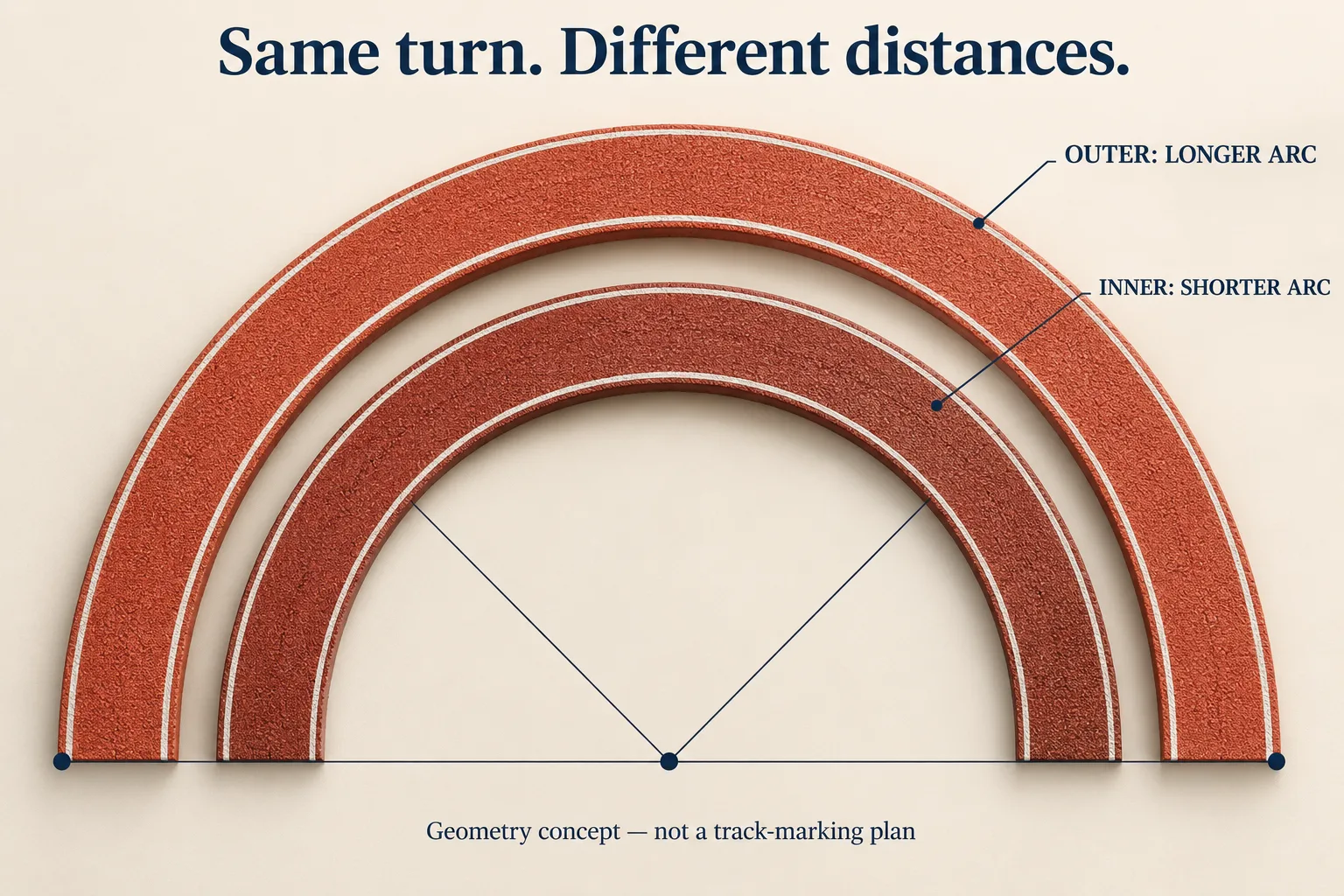
Imagine two semicircular paths around the same centre. The one with the larger radius has a longer arc. Add equal-length straights to those curves and the outer circuit is still longer. Starting everyone on the same cross-track line, keeping them in separate lanes for a full circuit and finishing on the same line would therefore give them unequal distances.
A stagger moves the starts along the lanes to compensate for the different routes. The Western Australian government’s track-dimensions guide explains the equal-distance principle and provides different stagger tables for different events. The geometric idea is simple; laying out a competition track is a specialist measurement task. Our diagram illustrates the idea and is not a marking plan.
Start and finish are different reference points
World Athletics’ 400m explanation describes one lap of a standard outdoor track, with athletes remaining in their designated lanes. Their starts are staggered, but they share the finish line. Being farther around the bend in a photograph does not, by itself, show who has covered more of their required race distance.
When watching, identify the finish before interpreting the apparent gaps. Compare runners as they approach that common reference rather than treating their starting positions as a lead. A television camera angle can make the lane offsets difficult to judge. The official result, rather than a screenshot from the bend, establishes the finishing order.
Why the 400m and 800m do not use one start
The official 800m overview describes a standing start from staggered positions and a lane break after the first bend on a standard 400m track. That differs from a 400m race that stays in lanes throughout.
| Event | Lane use | What to watch |
|---|---|---|
| 400m | Separate lanes throughout. | Different starts, common finish. |
| 800m, lane start | Lanes to the first-bend break line. | The marked transition to shared running space. |
The government’s table lists different 400m and 800m staggers. You cannot choose a start simply because the race finishes at the same place, or because both events pass around the same oval. The distance covered in lanes and the permitted route afterwards matter. An event label belongs with its marking; a nearby painted line is not automatically the correct start for your race.
Find the break line before judging the move
In the current World Athletics technical rules, Rule 17.5.1 describes the 800m break line as an arc after the first bend, with small markers helping athletes identify it. Runners may leave their lanes at its nearer edge. The rule also allows specified competitions to agree not to use lanes, so the table describes the lane-start format rather than every possible meeting.
The break line is not a second starting signal or a finish line. Nor does reaching it remove the rules against obstructing other athletes. Watch for the marked location and the runners’ movement into shared space; do not infer a breach solely because they are no longer running in separate lanes.
Keep the venue and event together
A 200m short track has different arrangements. Under Rule 44.6.3 in the same rulebook, an 800m race started in lanes uses the break line after the second bend. Group starts have separate provisions. Do not transfer the standard 400m-track first-bend explanation to every indoor broadcast.
For more context, our middle-distance guide explains the event family, while the athletics overview places track races within the wider sport. Neither the runner’s shoes nor their lane number tells you which start format the meeting has selected.
Practical takeaway
Read a race in this order: venue, event, start arrangement, lane-break point and finish. A stagger compensates for route geometry; a break line marks a permitted change in lane use. For participation, use the organiser’s current instructions and ask an official to identify the correct markings. For viewing, those same distinctions explain why runners can begin apart and later race together.
Sources
- Athletics track events — standard track dimensions, Government of Western Australia
- 400 Metres — how it works, World Athletics
- 800 Metres — how it works, World Athletics
- Competition Rules & Technical Rules — July 2026, World Athletics
Continue reading
Related articles

Swim Training Basics for New Lap Swimmers
Lap swimming becomes less intimidating when you know the lane etiquette, start with generous rests and focus on calm technique. Build a pool routine one short repeat at a time.
Gun time vs chip time: read a road-race result
Understand gun and chip time with a worked race example, check wave and ranking labels, and collect the right details when a result needs correction.

Tennis scores: sets, tiebreaks and bracketed results
Read tennis set scores, tiebreak points and bracketed results. Use worked examples to distinguish a set tiebreak from one that replaces the deciding set.