Badminton court lines: serve boundaries versus rally boundaries
See which badminton lines apply to singles, doubles, serves and rallies. Compare the landing areas, the rear service line and three common line-call examples.
On this page
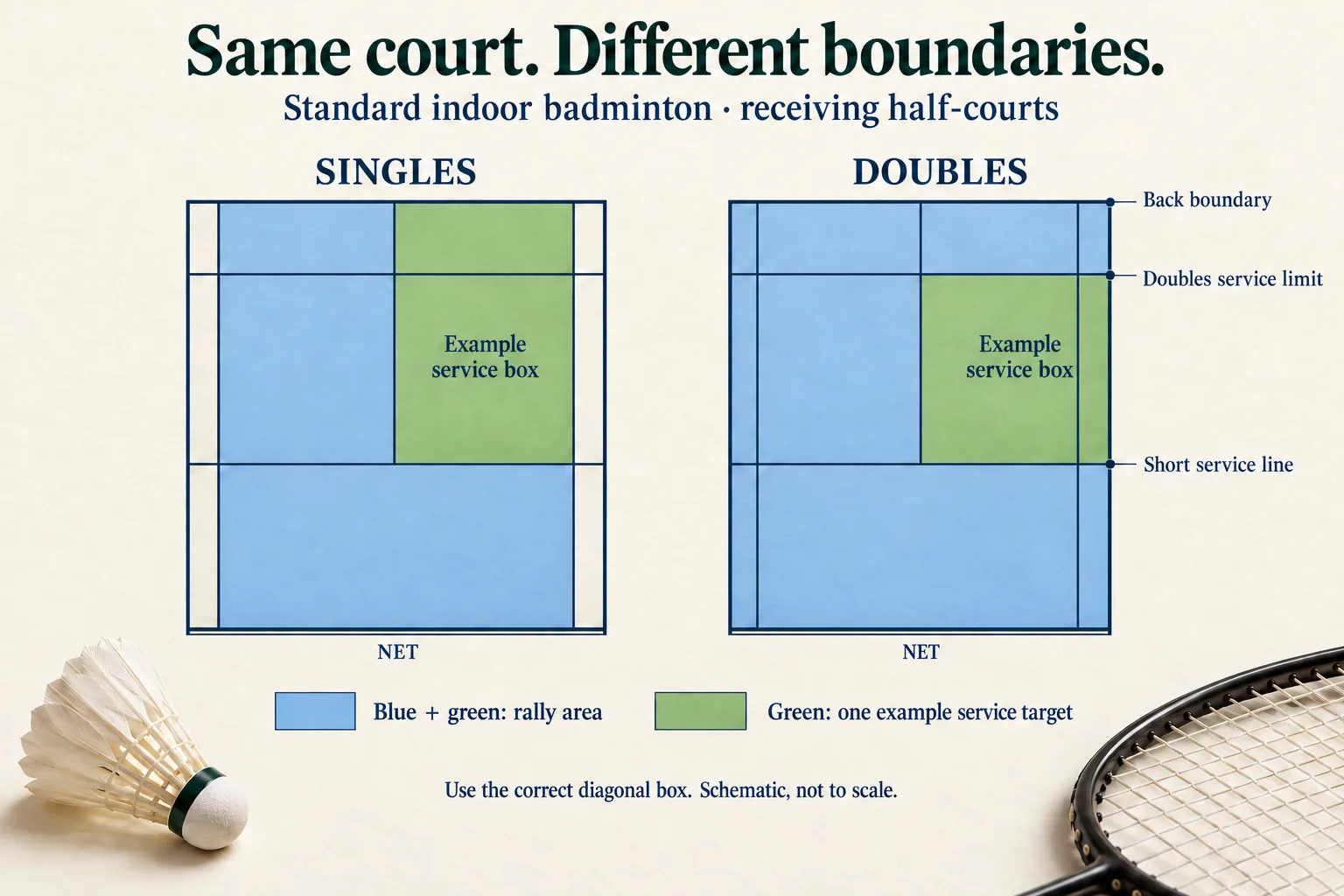
In badminton, a shuttle can land inside the doubles court yet be too long for a doubles serve. The court does not change; the relevant boundary does. Singles uses the inner sidelines, while doubles uses the outer sidelines, and the rear limit for a doubles serve sits in front of the back boundary.
Start with two questions: are you playing singles or doubles, and is this the serve or a later shot? This guide covers standard indoor badminton. Adapted para-badminton courts and outdoor formats need their own rules.
Find the playing width first
Badminton New Zealand’s basics guide describes singles as using a narrower court and doubles as using the full width. On a court marked for both, the two long lines nearest the centre are the singles sidelines. The outer pair are the doubles sidelines.
The narrow strips between those pairs of lines are therefore outside the singles playing area. In doubles, they are part of it. This applies to the width of the receiving service box as well as the width available during a rally.
Before a casual game, point out both sidelines to your partner or opponent. Saying “the outside line” without identifying the format can leave two people picturing different boundaries. Floor markings for another sport should not become part of your badminton court.
A serve has a diagonal landing box
The BWF Laws of Badminton place server and receiver in diagonally opposite service courts. If the serve is not intercepted, it must land on or inside the receiver’s service-court boundaries.
The short service line sets the front limit. The centre line divides the left and right boxes. In singles, the rear limit is the back boundary. In doubles, it is the separate long service line just inside that boundary. The strip behind that doubles service line is too deep for a serve, even though it belongs to the later rally area.
The original illustration shows one example receiving box in green. It does not mean either box can be chosen freely, or that both boxes are valid for the same serve.
Compare the four landing areas
| Situation | Side limit | Rear limit |
|---|---|---|
| Singles serve | Inner sideline of the diagonal box | Back boundary |
| Singles rally shot | Both inner sidelines | Back boundary |
| Doubles serve | Outer sideline of the diagonal box | Inset doubles long service line |
| Doubles rally shot | Both outer sidelines | Back boundary |
The service rows also require the correct side of the centre line and a landing no nearer the net than the short service line. After the serve is returned, those two markings no longer fence off the shuttle’s landing area. A return may land near the net or across the centre line, provided it remains within the appropriate court and no other fault occurs.
Judge the first contact, including the line
The BWF Line Judges’ Manual explains that the shuttle’s initial contact with the floor determines the call. A landing on the relevant boundary line is in. Where the shuttle rolls or comes to rest afterward does not change that first contact.
Keep shuttle landings separate from foot placement. During service, the server and receiver must stand within their service courts without touching their boundary lines. “On the line is in” does not give them permission to stand on a service line.
Try three landing examples
- Deep in doubles: a serve first lands behind the inset rear service line but before the back boundary. It is long. The same landing position on a later rally shot is inside the court.
- Wide in singles: a shuttle first lands between the inner and outer sidelines. It is out in singles, even if it has not crossed the outer line.
- Exactly on the short service line: a serve first touches that line within the correct diagonal box. Its landing is in; other service requirements still apply.
These are hypothetical line calls, not a complete checklist for every fault. For a separate racket-sport rule question, see our table-tennis service-let guide; do not transfer its net-contact rule to badminton.
Practical takeaway
Identify the format, then identify the shot. Use the inner sidelines for singles and the outer sidelines for doubles. For a serve, trace the diagonal box all the way around, especially its rear edge. For a rally shot, use the appropriate full playing area. Our sports guides explain other commonly confused markings and match situations.
Sources
- Badminton Basics, Badminton New Zealand
- Laws of Badminton, in force 26 April 2025, version 5.0(2), Badminton World Federation
- BWF Line Judges’ Manual, Badminton World Federation
Continue reading
Related articles
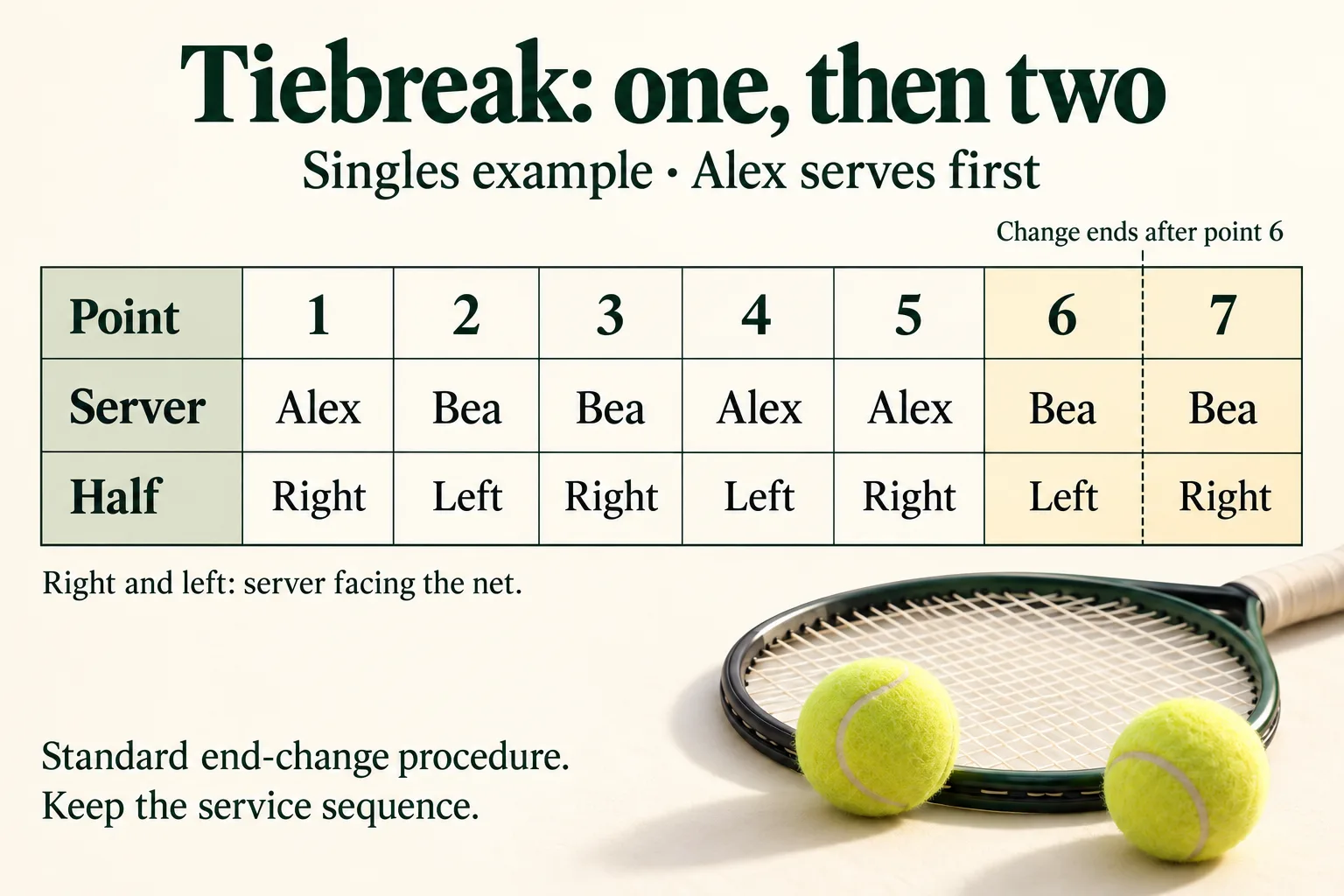
Tennis tiebreak serving order: points, sides and ends
Follow a singles tennis tiebreak point by point: who serves, right or left half, when to change ends, and who starts the next set.
Table-tennis lets: replay the serve or lose the point?
Learn when a table-tennis net serve is replayed, when the server loses a point, and why a correct rally return can touch the net without stopping play.
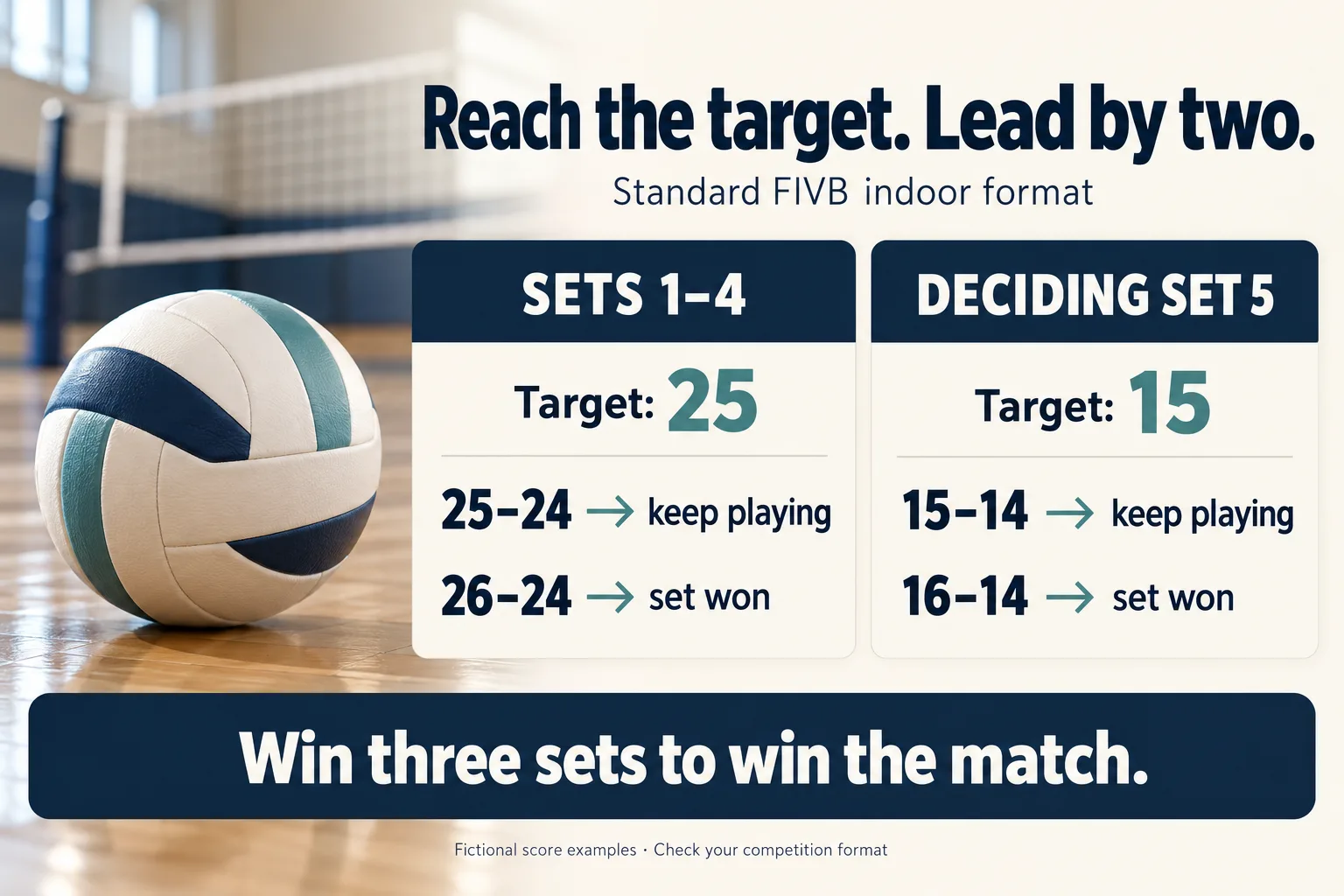
Indoor volleyball scoring: 25 points, 15 points and sets
Read indoor volleyball scores, know when a set needs more than 25 points, and see why only a deciding fifth set uses 15 in the standard FIVB format.