Tennis tiebreak serving order: points, sides and ends
Follow a singles tennis tiebreak point by point: who serves, right or left half, when to change ends, and who starts the next set.
On this page
At 4–2 in a tennis tiebreak, both players walk to the other end of the court. Does the server change too? Not necessarily: that move can split one player’s two-point serving turn. Keep three questions separate: who serves, which half they serve from, and which physical end they occupy.
This guide follows an ordinary singles set tiebreak, with Alex serving first and Bea receiving. The names and situations are invented examples. Doubles rotations and alternative competition formats need their own rules.
Start with one point, then pairs
The player next due to serve starts the tiebreak. The opponent then serves twice, and the players continue alternating two-point turns. The USTA scoring guide explains that the first point starts from the deuce, or right, side; the opponent’s pair begins from the ad, or left, side.
Right and left are from the server’s perspective while facing the net. The serving half alternates with each point, independently of the player’s identity. Count points in the tiebreak, not games in the set.
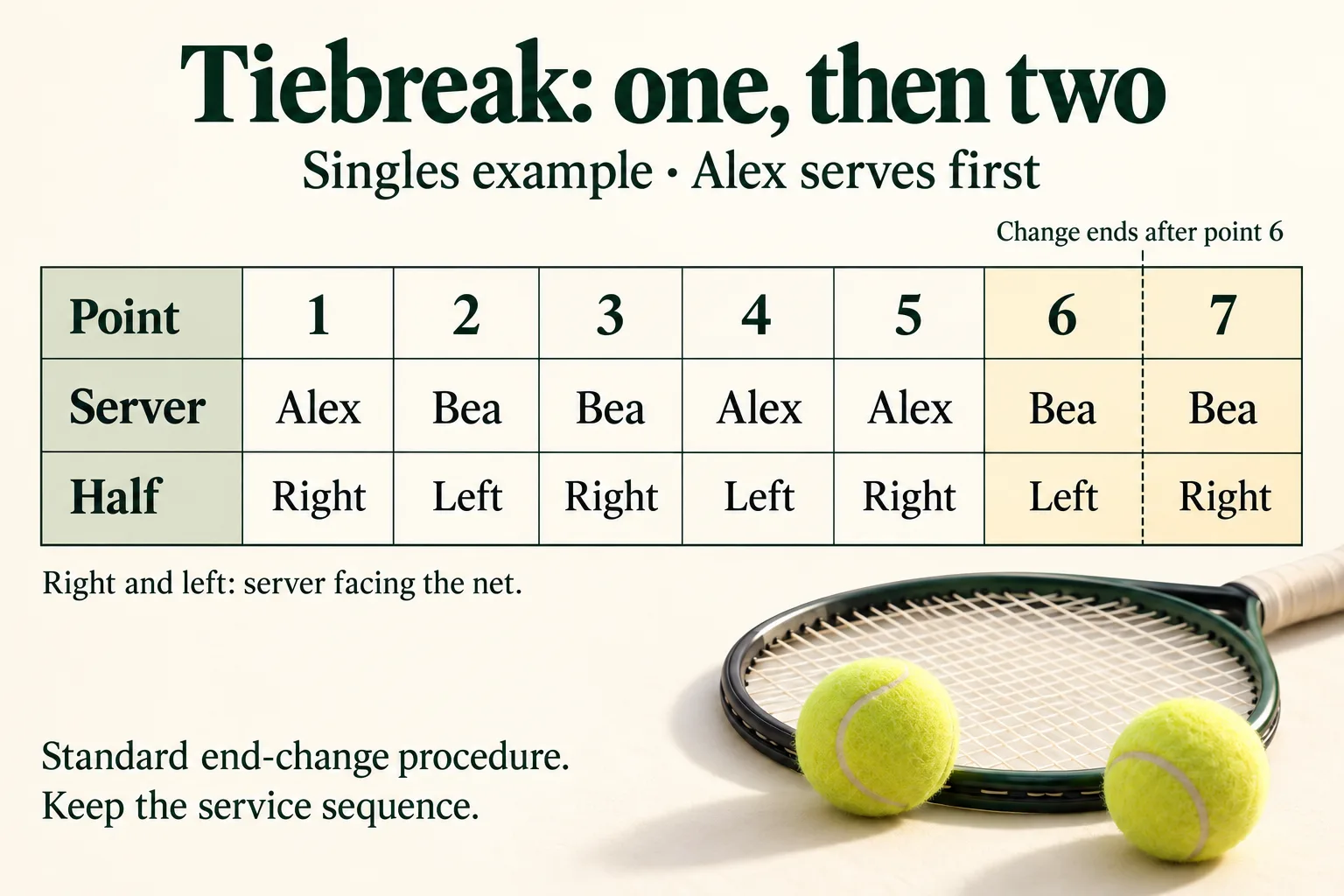
| Point | Server | Half |
|---|---|---|
| 1 | Alex | Right |
| 2 | Bea | Left |
| 3 | Bea | Right |
| 4 | Alex | Left |
| 5 | Alex | Right |
| 6 | Bea | Left |
| 7 | Bea | Right |
After point seven, Alex serves points eight and nine, provided the tiebreak continues. The table shows service responsibility, not who wins each point. A player losing a point does not hand over a serving turn early.
Changing ends does not reset the sequence
Under the standard procedure, players change physical ends after six points, then twelve, eighteen and so on. The 2026 ITF Rules of Tennis set out that procedure in Rule 10, alternating serving halves in Rule 17, and continuous play without a rest during tiebreak end changes in Rule 29.
Look at points six and seven in the table. Bea serves both, but from different ends of the court. Before the move, Bea serves from the left half. After the move, Bea serves from the right half while facing the net from the new end. Alex does not take over merely because everyone walked across.
Use the score to find the next point
Add the two scores to find how many points have been completed, then add one for the next point. If Alex leads 4–2, six points are finished and point seven is next: Bea serves from the right after the standard end change.
A score of 3–3 produces the same answer. The distribution of those six points does not affect the service schedule. At 5–4, nine points are finished, so Bea serves point ten from the left. At 6–6, twelve are finished: change ends, then Alex serves point thirteen from the right.
That calculation still needs one missing input: who served first. If Bea began the tiebreak, reverse the names throughout the table. A score alone identifies the point number and serving half, but not the player.
Remember who received first for the next set
The USTA’s next-server explanation makes the useful distinction: the first receiver in the tiebreak serves the opening game of the following set. Its length does not change that rule.
In our example, Bea serves first next set whether Alex or Bea wins the tiebreak. Do not base that decision on who served the final point. Write down the first server before play begins if you are keeping a scorecard. If the match finishes with this set, there is no next-set service to arrange.
Check whether an alternative procedure applies
The standard six-point end-change schedule is not universal. Appendix VI of the ITF rules also permits changing ends after point one and then every four points: after five, nine, thirteen and so on. Confirm the event’s procedure before using the diagram.
Separate that question from the points needed to win. Our tennis score-notation guide explains set tiebreaks and match tiebreak results. This singles example does not settle doubles receiving positions, short-set variations or how an official should correct an error already made.
Practical takeaway
Record the first server, count completed points and keep the serving half separate from the court end. At an end change, continue the existing service sequence. For an organised match, ask the official about a disputed order rather than inventing a correction. Find more event explainers in Sports & Athletics.
Sources
- Scoring Points & Tennis Sets, United States Tennis Association
- 2026 ITF Rules of Tennis, International Tennis Federation
- Who serves next after a tiebreak?, United States Tennis Association
Continue reading
Related articles

Table-tennis lets: replay the serve or lose the point?
Learn when a table-tennis net serve is replayed, when the server loses a point, and why a correct rally return can touch the net without stopping play.
Badminton court lines: serve boundaries versus rally boundaries
See which badminton lines apply to singles, doubles, serves and rallies. Compare the landing areas, the rear service line and three common line-call examples.
Tennis scores: sets, tiebreaks and bracketed results
Read tennis set scores, tiebreak points and bracketed results. Use worked examples to distinguish a set tiebreak from one that replaces the deciding set.