Fabric percentages: read shell and lining separately
Understand fabric percentages by garment section. Two fictional examples show why shell and lining figures cannot be averaged without their fibre weights.
On this page
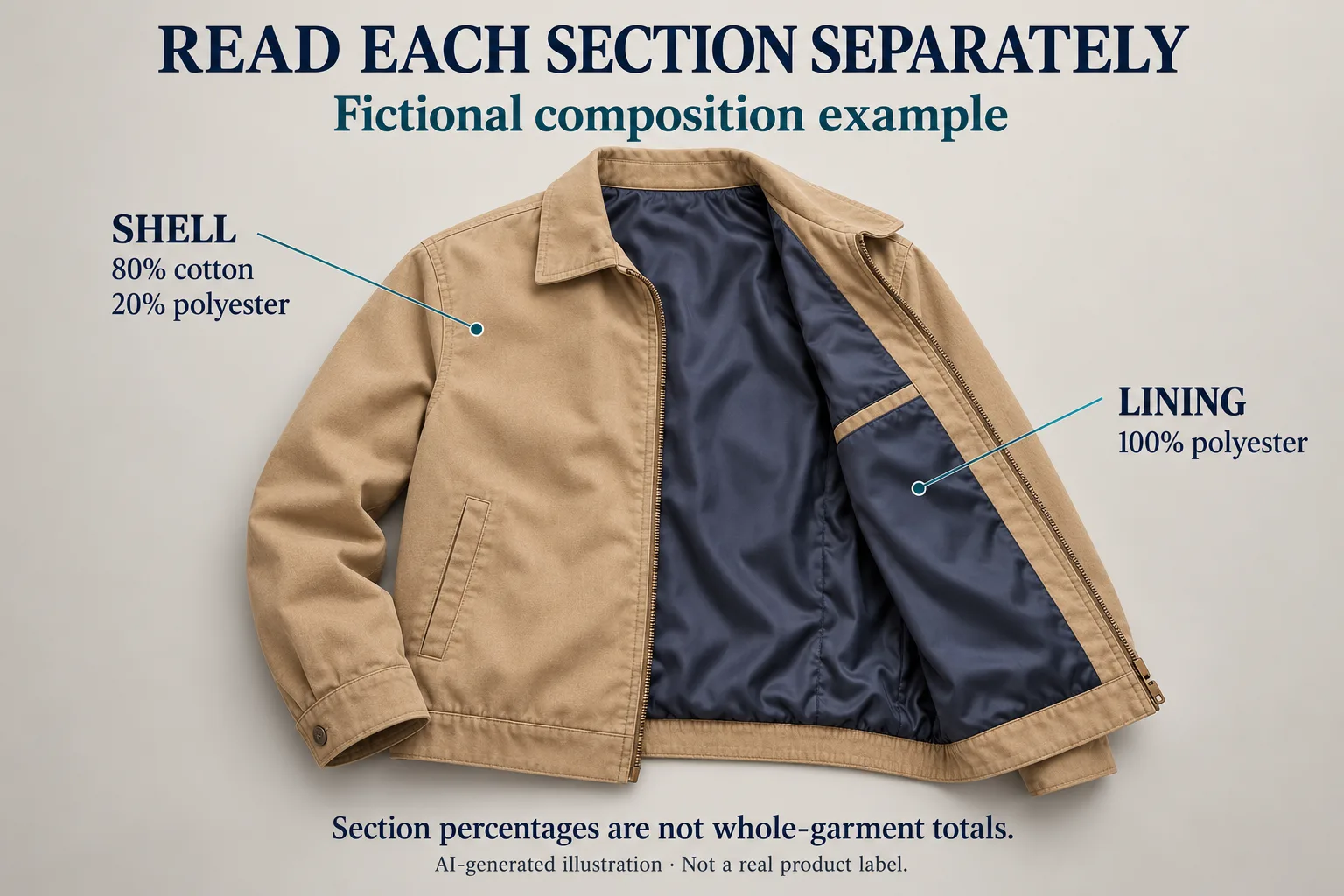
A jacket description can list cotton and polyester for the shell, then polyester again for the lining. Adding those percentages together will not tell you what the entire jacket is made from. Each section has its own reference weight, and the shell and lining need not weigh the same.
Read a composition statement in two parts: the named section and the fibre mixture within it. The fictional examples below show why keeping those parts together matters when comparing activewear or everyday clothing. They are arithmetic illustrations, not tested products or model labels for manufacturers.
Start with the section name
The US textile rules describe composition in percentages by fibre weight and permit separate fibre descriptions for sections with different compositions. Keep that regional context in mind: these are US rules, not a statement that every country uses identical labelling requirements. This guide explains how to compare the numbers, not how to certify a manufacturer's label.
For shopping purposes, preserve headings such as “shell”, “lining”, “body” and “sleeves” when you copy information into a comparison note. Do not move a number under one heading into another section. If you cannot tell which part a listing describes, ask the seller before treating it as a whole-item figure.
A blend is different from a second layer
Imagine a description reading “Shell: 80% cotton, 20% polyester. Lining: 100% polyester.” The shell statement describes one mixture. The lining statement describes another section. The two lines are not a single list that should add up to 100%, and “100% polyester” does not erase the cotton in the shell.
Nor can you average the shell's 80% cotton and the lining's 0% cotton to announce “40% cotton overall”. That calculation silently gives both sections equal weight. It only produces the combined cotton proportion if their fibre weights really are equal.
The same printed percentages can give different totals
Consider two imaginary constructions with exactly those section compositions. For this calculation, include only the fibres in the shell and lining. Exclude buttons, zips, coatings and any other components. The invented weights are not typical product specifications, and weighing an intact jacket would not reveal them.
| Calculation | Example A | Example B |
|---|---|---|
| Shell fibre weight | 180 g | 60 g |
| Lining fibre weight | 60 g | 180 g |
| Cotton in these two sections | 144 g | 48 g |
| Cotton share of their combined 240 g | 60% | 20% |
In Example A, 80% of the 180 g shell is 144 g of cotton. Divide 144 g by the combined 240 g of fibre to get 60%. The remaining 96 g is polyester: 36 g in the shell plus 60 g in the lining.
In Example B, 80% of the 60 g shell is 48 g of cotton. Divide 48 g by 240 g to get 20%. The other 192 g is polyester: 12 g in the shell plus 180 g in the lining. The section percentages stayed unchanged; their weights changed the combined result.
These calculations explain the missing information. They are not instructions to unpick clothing, estimate component weights from photographs or create a replacement label. Without the relevant weights, retain the separate composition statements instead of inventing an overall percentage.
Compare the exact listings
UNIQLO EU's product-information FAQ says its product pages provide material composition and points readers to customer support for unanswered questions. Look for that information on the exact item and regional listing you are considering, rather than relying on a search-result title or a similar-looking product.
Keep the item reference, selected variant, section headings and complete fibre lines together. If one listing describes only the shell and another includes a lining, mark the missing detail as unknown. A useful question is: “Does this composition cover the shell only, and what information is available for the lining?” A second is: “Does this statement apply to the colour and product reference I selected?”
Keep composition, fit and care as separate decisions
A fibre percentage answers a composition question. Do not turn the number alone into a verdict about warmth, comfort, stretch, drying speed or durability. Look for product-specific evidence relevant to the feature you need; a higher percentage is not automatically a better choice.
For size comparisons, use the body-versus-garment measurement guide. For cleaning, read the actual care instructions and the sportswear-washing guide. A composition calculation supplies neither a size recommendation nor permission to use a particular wash or drying setting.
Practical takeaway
Carry the section name along with every fibre percentage. Compare equivalent sections, keep missing details visible and resist adding or averaging separate lines. The useful outcome is a clearer product comparison and a precise question for the seller, not an unsupported whole-garment number.
Sources
- 16 CFR 303.16: fibre percentages by weight (2025 edition; PDF), US Government Publishing Office
- 16 CFR 303.25: sectional disclosure (2025 edition; PDF), US Government Publishing Office
- UNIQLO EU: sizing, colours and materials, UNIQLO EU
Continue reading
Related articles
Clothing size charts: body or garment measurements?
Tell body measurements from finished-garment dimensions. Use a practical worksheet to compare chart labels, measurement routes, units and exact products.
Nike’s waffle sole: prototypes, patents and product dates
Read Nike’s waffle-sole history with its dates in context. Separate prototypes, patent filing and issue, and product accounts without hiding uncertainty.
Replacement shoelaces: count pairs and measure one lace
Choose replacement shoelaces with a clear record: count eyelet pairs, measure a suitable old lace, and check the product’s length, shape and fastening type.