
Football added time: what the +4 board means
Read football’s added-time board, understand why play can continue beyond the minimum, and distinguish the allowance from extra time.
On this page
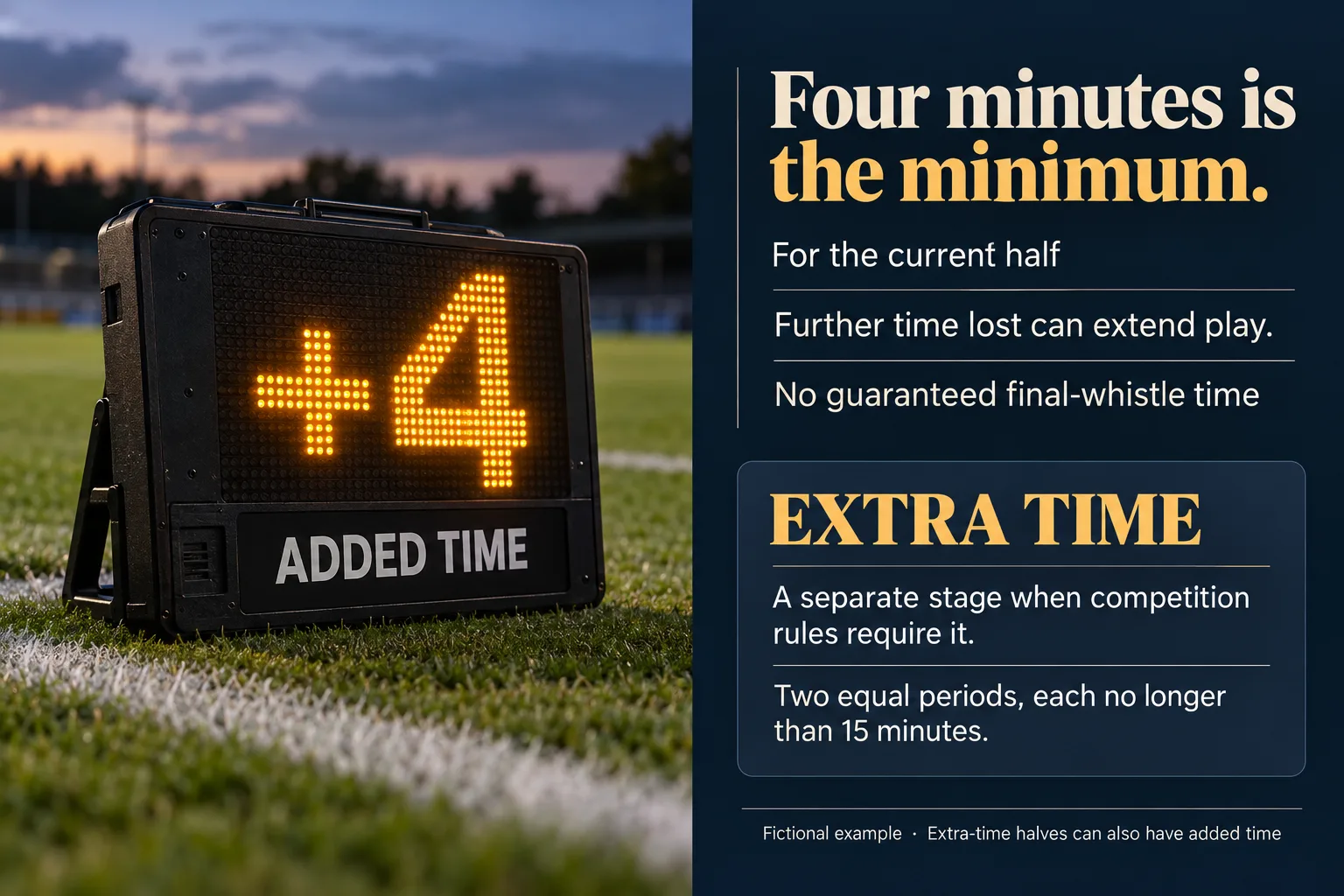
A board showing four additional minutes near the end of a football match tells you something useful, but it cannot promise the exact moment of the final whistle. The number belongs to the current half and needs to be read alongside the stage of the match.
This guide follows the IFAB Laws of the Game for 2026/27. The displays below are fictional examples. For a youth, recreational or modified competition, check its own playing-time rules.
Read the board as a minimum
Law 7 on match duration makes the key qualification clear: the announced additional time is a minimum. The referee can increase it, but cannot reduce it.
Suppose a fictional display shows 90:00 and a separate +4 allowance. Read that as at least four additional minutes for the second half. Do not turn it into an appointment for a whistle at precisely 94:00. The display does not reveal what might interrupt the remaining play.
The same principle applies at half-time. A +2 announcement near the end of the first half concerns that half; it is not a credit to carry into the second. Law 7 also expressly prevents a first-half timekeeping error being corrected by changing the second half’s length.
Separate the decision from the signal
The referee decides the allowance. Under Law 6’s fourth-official duties, the fourth official indicates the minimum the referee intends to play at the end of each half, including halves of extra time.
That distinction matters when discussing a match. “The board showed four” describes an announcement. It does not establish that the person holding the board independently selected four minutes, or that a television display is the referee’s timekeeping record.
Keep the team score separate too. An allowance of +4 says nothing about which side is winning, how many goals have been scored or whether the match is level.
Allow for further interruptions
The IFAB’s plain-language playing-time guide explains that the referee must increase the allowance for further time lost during additional time itself. It identifies causes such as substitutions, injuries, goal celebrations and delays for video checks or reviews.
A useful viewing habit is to keep two notes: the allowance announced, and any later interruption. Those notes help explain why play may continue beyond the first number. They do not let a viewer calculate an authoritative finish from an incomplete broadcast.
A penalty is another specific consideration. Law 7 requires the half to be extended when a penalty must be taken or retaken, until it is completed. This provision concerns that penalty; it is not a general promise to keep playing until an attacking move produces a goal.
Recognise extra time as a separate stage
Law 10 on deciding a match treats extra time as one permitted procedure when competition rules require a winner after a draw. It consists of two equal periods, each no longer than 15 minutes. The competition’s rules determine which permitted procedure or combination applies.
Consequently, +4 at the end of normal time does not mean the match has entered extra time. A drawn match does not automatically require two more periods either. Establish the competition format before interpreting what comes next.
Extra time can itself have additional time. The two expressions answer different questions: which stage is being played, and what allowance is being made within its half?
Read three fields together
Use this fictional viewing card to keep the stage, clock and announcement distinct. It illustrates interpretation rather than a real match’s timing:
| Stage | Display | Read it as |
|---|---|---|
| First half | 45:00; +2 | Minimum for this half |
| Second half | 90:00; +4 | Minimum for this half |
| Extra time | Period 1; +1 | Allowance in that period |
Notice that the last row identifies the stage explicitly. A plus sign alone cannot do that. The same habit of separating a display’s fields helps with our volleyball points-and-sets guide, although the sports use different rules.
Practical takeaway
Identify the half, read the announced minimum and check whether extra time is actually part of the competition’s format. Keep an allowance separate from a predicted finishing time. For more explanations of results and event formats, browse Sports & Athletics.
Sources
- Law 7 — The Duration of the Match, IFAB
- Law 6 — The Other Match Officials, IFAB
- Playing times, IFAB Football Rules
- Law 10 — Determining the Outcome of a Match, IFAB
Continue reading
Related articles
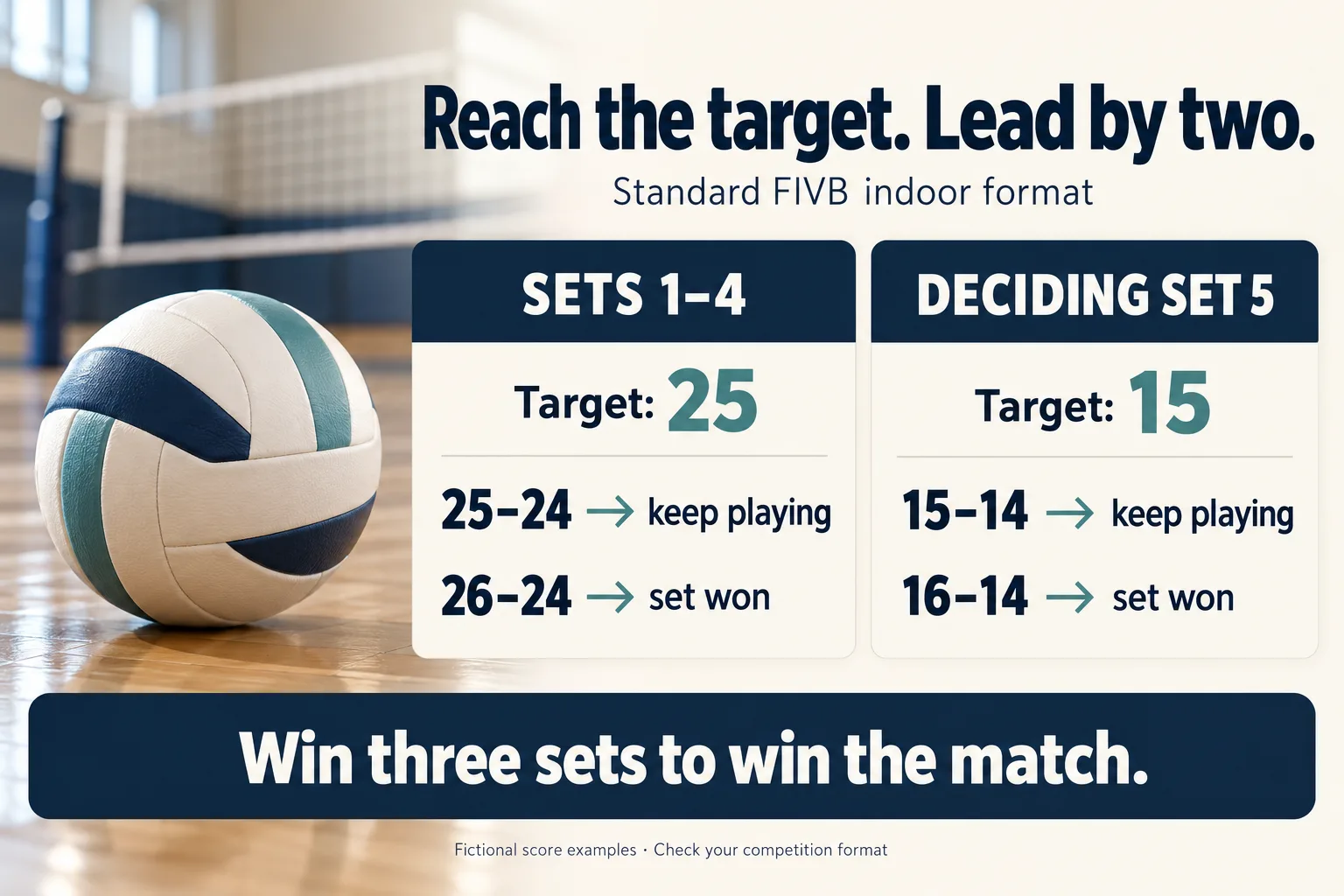
Indoor volleyball scoring: 25 points, 15 points and sets
Read indoor volleyball scores, know when a set needs more than 25 points, and see why only a deciding fifth set uses 15 in the standard FIVB format.
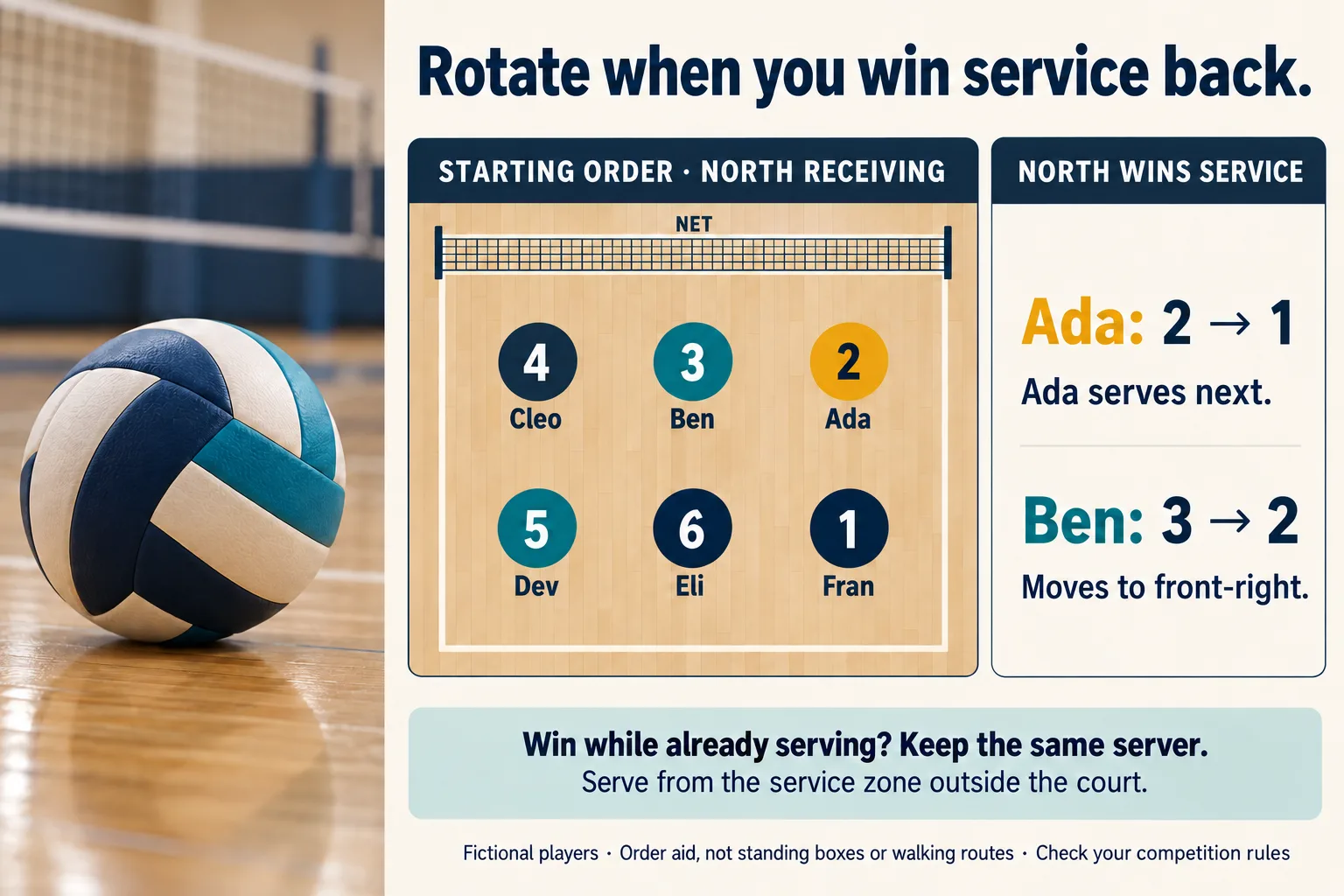
Volleyball rotation: service order and player positions
Learn when volleyball teams rotate, follow a fictional service sequence, and distinguish FIVB positioning rules from USA Volleyball’s requirements.
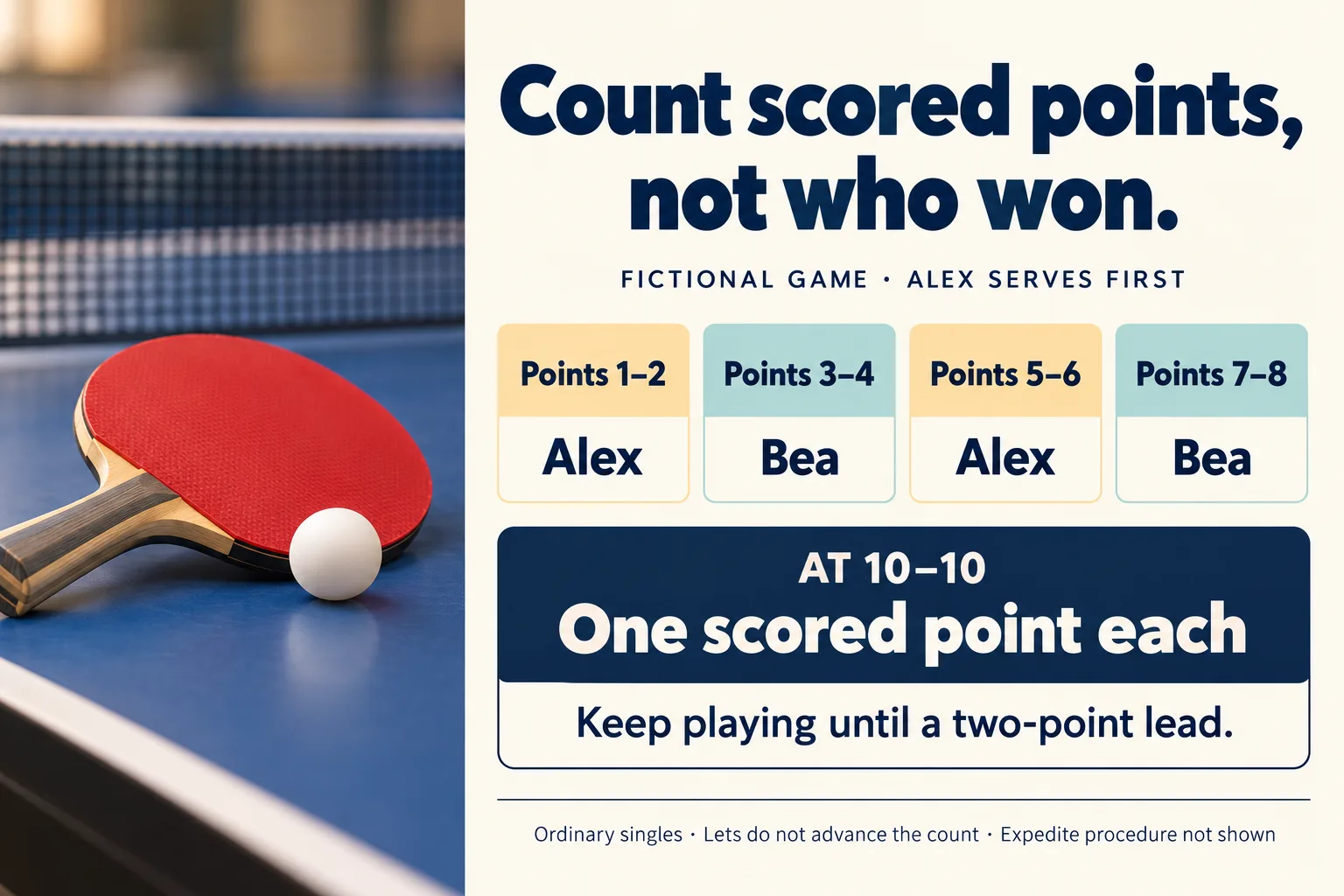
Table-tennis scoring: games, service turns and deuce
Follow table-tennis points, two-point service turns and deuce with a fictional scorecard. Keep match wins and deciding-game changes of ends separate.