Volleyball rotation: service order and player positions
Learn when volleyball teams rotate, follow a fictional service sequence, and distinguish FIVB positioning rules from USA Volleyball’s requirements.
On this page
A volleyball team wins a point, yet the same player serves again. A few rallies later it wins another point and everyone advances in the rotation. The difference is whether the team was already serving or has just won service back.
This guide follows standard FIVB indoor volleyball under the 2025–2028 rules. North, South and the player names below are fictional. The examples concern an ongoing set, with no substitutions or libero replacements.
Rotate when service changes hands
The FIVB basic-rules explanation connects clockwise rotation to winning a rally while receiving. Winning a rally while already serving does not trigger another rotation.
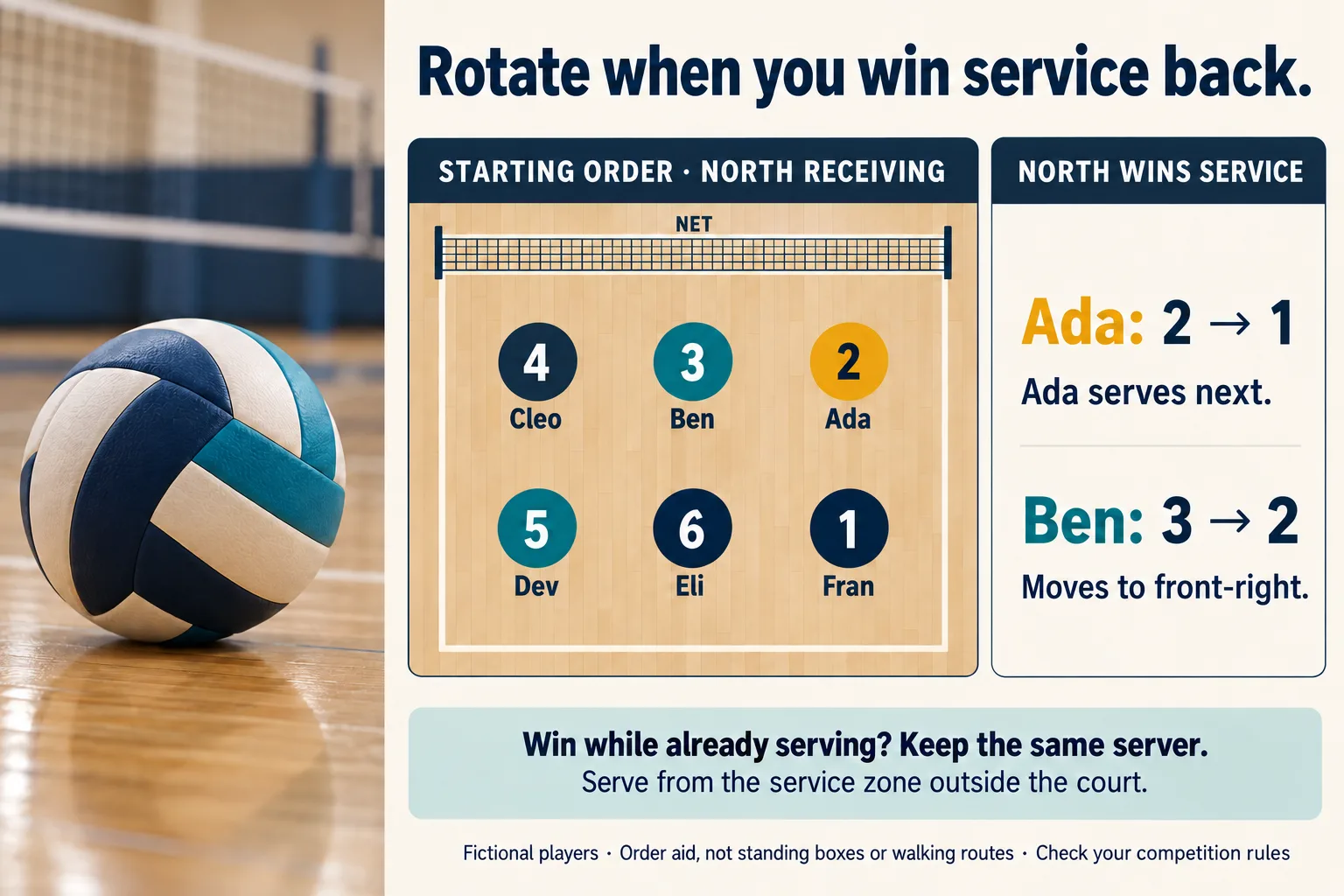
Imagine North is receiving from South. North wins the rally and gains service. North advances one rotational position before its next serve. If North wins again while serving, it keeps the same rotation and server. Do not count every point on the scoreboard as another step around the court.
Read the numbered positions
Facing the net from your own court, the front row is numbered 4, 3 and 2 from left to right. The back row is 5, 6 and 1. These are rotational positions, not shirt numbers or a ranking of players.
The clockwise sequence is 2 to 1, 1 to 6, 6 to 5, 5 to 4, 4 to 3 and 3 to 2. The player moving from position 2 to position 1 becomes the server.
For our example, North starts receiving with Ada in 2, Ben in 3, Cleo in 4, Dev in 5, Eli in 6 and Fran in 1. After North wins service, Ada occupies rotational position 1 and serves; Ben has moved to 2. The illustration highlights Ada’s change, not a prescribed walking route or tactical formation.
Follow three consecutive rallies
Assume each rally below produces an ordinary point and the set continues. Read the rows in order:
| North’s rally | Rotate? | Next server |
|---|---|---|
| Receive and win | Yes | Ada |
| Serve and win | No | Ada |
| Serve and lose | No | South |
In the third row, South rotates because South won while receiving. North does not take an extra step merely because it lost service.
If North later wins service back, it rotates again and Ben moves from 2 to 1 to serve. Ada moves from 1 to 6. The order has advanced once for each occasion North regained service, even if several points were played between those occasions.
A replayed rally adds neither a point nor a rotation. Keep a simple record of the serving team before each rally and the awarded outcome afterward. Our volleyball scoring guide explains the separate points-and-sets calculation.
Separate order from formation
FIVB rules 7.4, 7.6 and 12.2 distinguish rotational order from physical placement. At service contact, receiving players must maintain the required relative order. Serving players may occupy any position within their court, apart from the server in the service zone. The correct player must still serve, and screening remains prohibited.
After service contact, players may move. Moving closer to the net does not turn a back-row player into a front-row player; attack and blocking restrictions still apply. The numbered diagram is therefore an order aid, not six boxes that everyone must stay inside throughout a rally.
Check the competition’s rulebook
Do not assume the FIVB positioning provision applies everywhere. USA Volleyball’s 2025–2027 book, under USAV 7.4, requires both teams to be in rotational order at service contact, except the server. Its introduction also explains that particular competitions may use FIVB rules or specified modifications.
Before a match, identify the governing rules and event exceptions. Ask about service order separately from receiving alignment. Substitutions, libero replacements and correcting an error already made require their own provisions; this example does not resolve those situations.
Practical takeaway
Track who served, who won the rally and whether service changed teams. Advance the receiving team’s order when it wins service, then check the next server. Keep that order separate from where players move during play. For a disputed rotation, involve the official rather than inventing a correction from the score alone. Find more explainers in Sports & Athletics.
Sources
- Basic Rules, FIVB
- Official Volleyball Rules 2025–2028, FIVB
- USA Volleyball Indoor Rules 2025–2027, USA Volleyball
Continue reading
Related articles

Football added time: what the +4 board means
Read football’s added-time board, understand why play can continue beyond the minimum, and distinguish the allowance from extra time.
Table-tennis scoring: games, service turns and deuce
Follow table-tennis points, two-point service turns and deuce with a fictional scorecard. Keep match wins and deciding-game changes of ends separate.
Race bib timing tags: placement and care before the start
Check race-bib and shoe-tag instructions, keep the timing assembly intact, and prepare the right details for the event team if equipment or results go wrong.