Race bib timing tags: placement and care before the start
Check race-bib and shoe-tag instructions, keep the timing assembly intact, and prepare the right details for the event team if equipment or results go wrong.
On this page
Your race number may look like a sheet of paper, but the strip attached behind it can be part of the timing system. Other events issue a separate device for a shoe. Before pinning anything on, identify the kit you received and read its fitting instructions. This guide compares examples from timing providers and turns them into a practical pre-start check; your own event’s instructions govern the equipment you use.
Identify what your event issued
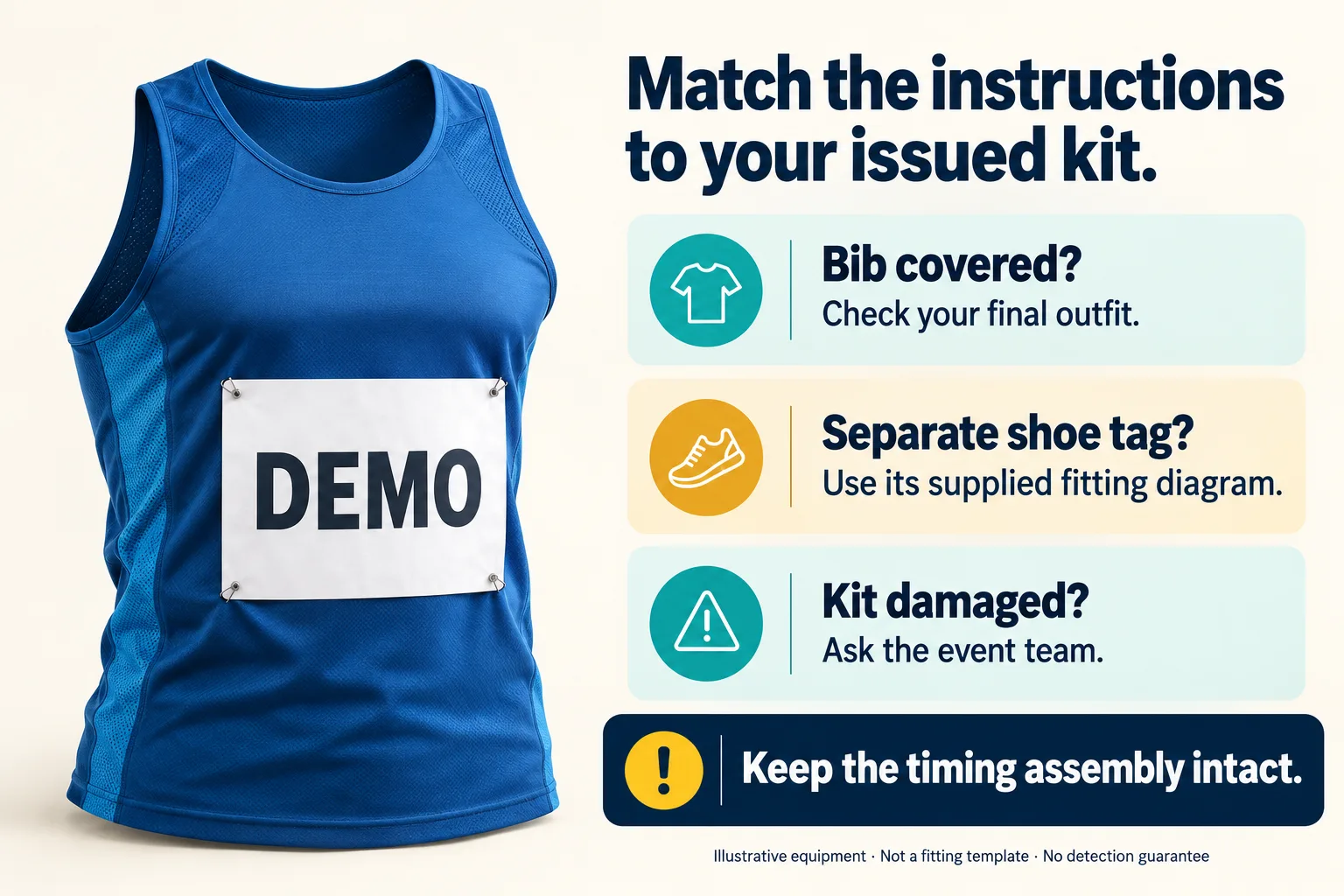
Sport Systems’ participant FAQ describes two options. Its reusable shoe chip attaches to either trainer with the supplied ties, following the illustration on the envelope. Its bib-chip system instead places the number on the front of the vest, with the chip left on the reverse. The provider specifically rules out wearing that bib on the back or legs.
These are different arrangements, not interchangeable suggestions. A photograph of another runner’s shoe tag does not tell you where your bib tag belongs. Match the instructions to the actual device in your pack. If a component or fitting diagram appears to be missing, ask the event team before improvising.
Check the bib with your final outfit
The standard running-bib instructions in RACE RESULT’s print-products data sheet call for the number to remain visible on the front of the torso. They also say that a jacket, shirt or hydration vest should not cover it. That is a specific manufacturer instruction for the illustrated bib products, not a placement rule for every kind of timing device.
Make your final clothing check after adding the outer layer and any pack you intend to wear. Imagine a runner who fixes the bib to a shirt, then puts a closed jacket over it: the bib has not moved, but it is now covered. Resolve that conflict using the event’s fitting directions, before joining the start. Our outdoor layering guide covers clothing adjustments; this extra check concerns the issued race number.
Leave the timing tag intact
RACE RESULT’s bib instructions warn against removing, folding or wrinkling the chip. Resist treating a raised strip on the reverse as disposable packaging. In its explanation of transponders with foam spacers, the manufacturer says the spacer creates distance between a running-bib tag and the body. It distinguishes those products from simple tags intended for uses away from the body, such as bike number plates.
That explains why an assembly can have more than one layer. It is not a recipe for adding your own foam, peeling the tag off or rebuilding it. The manufacturer’s organiser-facing installation guidance does not give a participant permission to relocate an already issued chip. Keep the supplied assembly together and refer questions about damage to the event team.
Use a short pre-start check
The following questions combine the provider examples with a final kit check. They do not replace the fitting diagram or establish that a device is working.
| Situation | Check | Next step |
|---|---|---|
| Outer layer | Bib covered? | Resolve before starting |
| Shoe tag | Fitting diagram matched? | Use the supplied fittings |
| Damaged kit | Tag or attachment damaged? | Ask event staff |
Report damage and result problems
If you lose the number or damage its tag, approach the registration or timing team. Let them decide what replacement or correction is appropriate. Do not assume a device from a previous event can substitute for the one assigned to you.
After the race, a missing result needs investigation rather than a guess about the cause. Sport Systems asks participants to provide the event name, bib number and estimated time. Treat that estimate as supporting information, not an official result. Our gun-time and chip-time guide explains the different starting references when a result does appear.
Practical takeaway
Identify the issued format, follow its fitting diagram, check the complete outfit and leave the timing assembly intact. Ask event staff about missing or damaged equipment. Correct-looking placement is a useful check, but it does not guarantee a timing detection or prove that a later result is accurate.
Sources
- Participant FAQs, Sport Systems
- Print Products Data Sheet, RACE RESULT
- Transponders on Roll (for self-adhesive), RACE RESULT
Continue reading
Related articles

Table-tennis scoring: games, service turns and deuce
Follow table-tennis points, two-point service turns and deuce with a fictional scorecard. Keep match wins and deciding-game changes of ends separate.
Volleyball rotation: service order and player positions
Learn when volleyball teams rotate, follow a fictional service sequence, and distinguish FIVB positioning rules from USA Volleyball’s requirements.

Football added time: what the +4 board means
Read football’s added-time board, understand why play can continue beyond the minimum, and distinguish the allowance from extra time.