Table-tennis scoring: games, service turns and deuce
Follow table-tennis points, two-point service turns and deuce with a fictional scorecard. Keep match wins and deciding-game changes of ends separate.
On this page
A table-tennis game reaches 11–10, but the players carry on. After the next point, the person who just lost may still be due to serve. Neither situation is a mistake: the winning margin and the service schedule answer different questions. This guide follows ordinary singles play using the 2026 laws reproduced by Table Tennis England. Alex and Bea are fictional players, and all scores are invented examples.
Win the game with a two-point margin
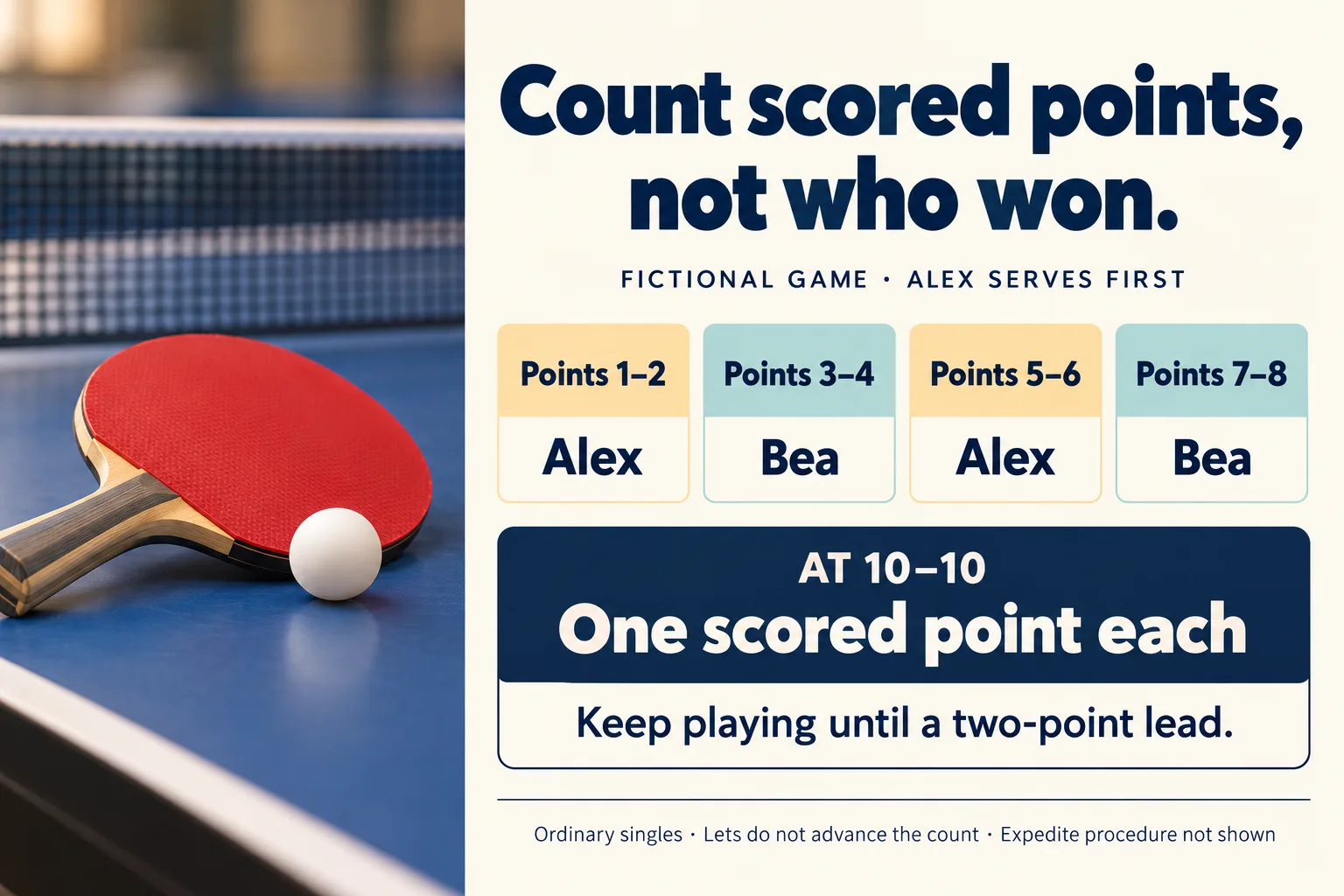
Table Tennis England’s scoring introduction explains the target of 11 points and what happens at 10–10. A player who reaches 11 before the opponent reaches 10 wins the game. Once both reach 10, play continues until someone leads by two.
For example, 11–8 finishes a game, while 11–10 does not. From 11–10, a point for the leader produces 12–10 and ends it; a point for the other player produces 11–11. The target does not become a sudden-death point at 12. At 14–14, the same two-point requirement still applies.
Count service turns separately
Table Tennis New Zealand’s beginner guide confirms that either player can score, regardless of who served. Do not confuse winning a rally with earning the next serve. In ordinary play before 10–10, service changes after every two scored points, not after every point the server wins.
If Alex serves first, Alex serves points one and two, Bea serves three and four, then Alex serves five and six. Keep that order even if one player wins every rally. Here, a “point” means a scored outcome, not every service attempt. Our table-tennis let guide explains why a genuine let is replayed without advancing the score or service turn.
Work through four scored points
Start a fictional game at 0–0 with Alex serving. The table keeps Alex’s score first throughout; it is a written scorecard, not a model of an umpire’s spoken score announcement.
| Point | Server | Score after |
|---|---|---|
| 1 | Alex | 0–1 |
| 2 | Alex | 1–1 |
| 3 | Bea | 2–1 |
| 4 | Bea | 2–2 |
Bea wins the first point, but Alex still serves the second. Alex wins the third while receiving, yet Bea serves the fourth. After four points, Alex begins the next pair. Adding the two scores tells you how many points are complete; you still need the identity of the first server to attach names to the sequence.
At 10–10, alternate every point
Rule 2.13.3 in the 2026–27 laws published by Table Tennis England changes service to one scored point each at 10–10. Alex, who served first in our example, serves the next point. Then Bea serves, then Alex, and so on while the game continues.
Suppose Alex wins for 11–10, Bea wins for 11–11, Alex wins for 12–11, and Alex wins again while Bea serves. The game ends 13–11. There is no extra turn for winning the preceding point. The laws also provide one-point service turns under the expedite system, so the ordinary two-point pattern is not universal. That separate procedure is outside this worked example.
Separate the match from changes of ends
A match uses the best of an odd number of games. In a best-of-five, three game wins finish it; five games are not compulsory. A 3–0 winner has won three games, not three points. Confirm the organiser’s format before starting.
Rules 2.13.6–2.13.7 also distinguish first service from physical ends. The first server in one game receives first in the next, and players switch ends between games. In the last possible game, they also switch ends when someone first reaches five points. For a best-of-five, that means game five, not game three merely because it eventually completes a 3–0 result. Moving ends does not restart the score or service sequence. Do not import the six-point end-change schedule from our tennis tiebreak guide.
Practical takeaway
Record the match format and first server. Keep game wins separate from the current point score, count scored points for service turns, and switch to one each at 10–10. For a disputed order or an unfamiliar competition procedure, ask the official rather than inventing a correction.
Sources
- Rules and how to play table tennis, Table Tennis England
- Rules of Play — A Simple Guide for Beginners, Table Tennis New Zealand
- The Laws of Table Tennis 2026–27, Issue 1, Table Tennis England
Continue reading
Related articles
Volleyball rotation: service order and player positions
Learn when volleyball teams rotate, follow a fictional service sequence, and distinguish FIVB positioning rules from USA Volleyball’s requirements.
Race bib timing tags: placement and care before the start
Check race-bib and shoe-tag instructions, keep the timing assembly intact, and prepare the right details for the event team if equipment or results go wrong.
Football added time: what the +4 board means
Read football’s added-time board, understand why play can continue beyond the minimum, and distinguish the allowance from extra time.