
Swimming split times: totals versus each interval
Read cumulative and interval swimming splits with a fictional 200 m table. Check minutes and hundredths, missing checkpoints and result status separately.
On this page
A swimming result can show four times for one 200-metre race without describing four separate races. Some numbers measure time since the start; others measure only the latest section. Before comparing them, read the distance headings and the report's split format. This guide uses invented readings to show the difference, not a real swimmer's performance or a training target.
Find the starting point of each number
A cumulative split is the elapsed time from the start to a checkpoint. An interval split covers the section between two checkpoints. HY-TEK's MEET MANAGER 8 documentation describes report options for cumulative, or running, splits; subtracted splits; and both formats together. That is one provider's reporting system, not a promise that every results page uses identical labels.
Read the legend before interpreting a row. A time at 100 m might be the total for the first 100 m, or the time for a section ending there. Preserve the event distance, stroke, course unit and round when copying a result. Two numbers with similar formatting may describe different swims.
Follow one fictional 200-metre example
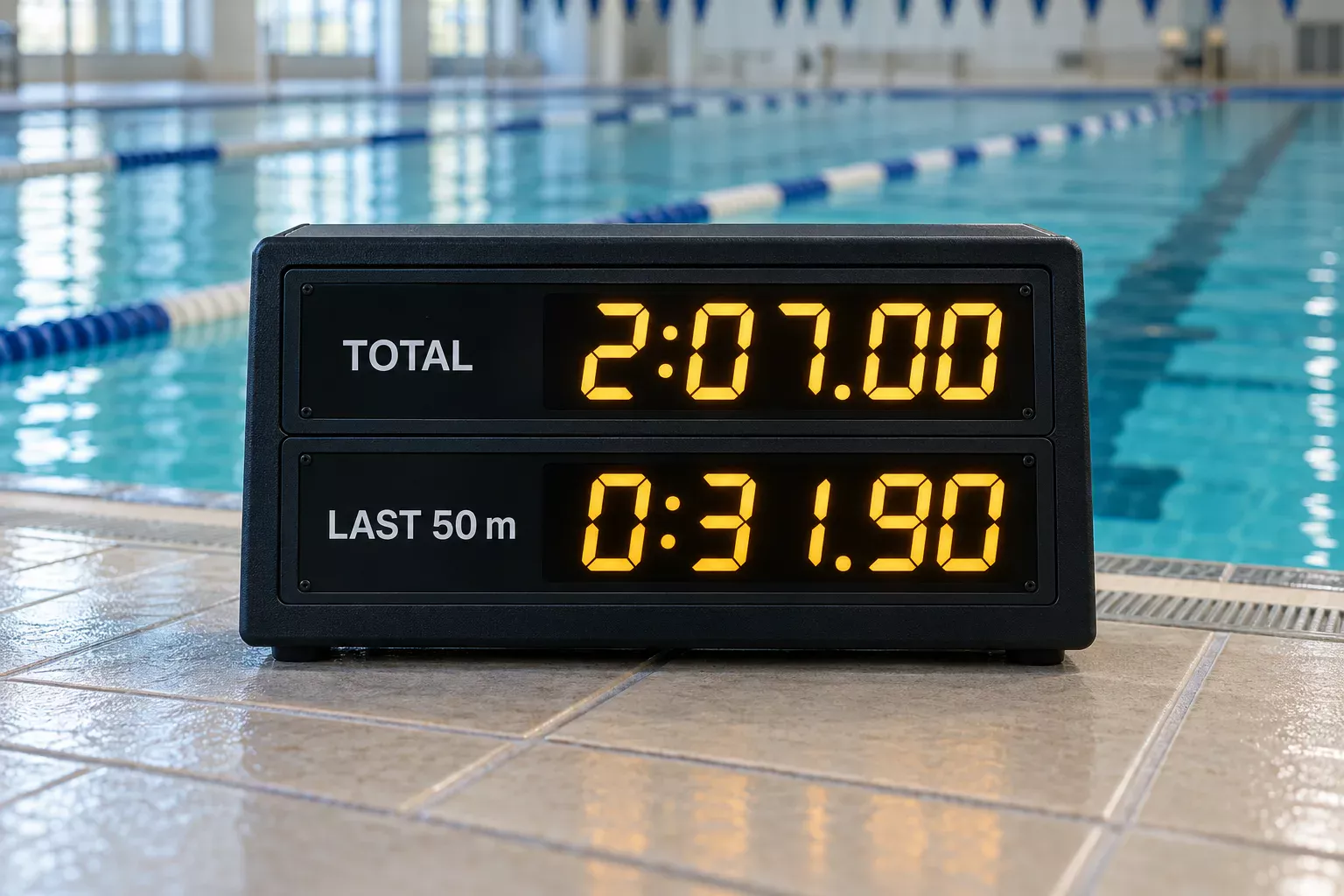
Imagine a result with checkpoints every 50 metres. The middle column below runs from the start; the right column covers only the latest 50 metres. All values are invented and use minutes:seconds.hundredths. The final cumulative reading is the total for this example.
| Distance | Cumulative | Latest 50 m |
|---|---|---|
| 50 m | 0:30.20 | 0:30.20 |
| 100 m | 1:02.50 | 0:32.30 |
| 150 m | 1:35.10 | 0:32.60 |
| 200 m | 2:07.00 | 0:31.90 |
The first pair matches because both readings begin at the start. Later pairs answer different questions. At 150 m, the swimmer has accumulated 95.10 seconds, while the section from 100 m to 150 m took 32.60 seconds. Neither reading should replace the other's heading.
Subtract elapsed times without decimal confusion
Convert the minute field before calculating. In this example, 1:02.50 means 62.50 seconds, not 1.025 minutes. Subtracting 30.20 from 62.50 gives 32.30 seconds for the second 50 metres. Similarly, 127.00 minus 95.10 gives 31.90 seconds for the last section.
For an exact hand check, work in hundredths: 6,250 minus 3,020 equals 3,230 hundredths. Adding the four interval values gives 12,700 hundredths, or 2:07.00. Adding the cumulative column would repeatedly count time already included in later readings. It would not calculate the race total.
These calculations check the consistency of the displayed example. They do not prove that timing equipment recorded a real race correctly, nor recover precision that a report has omitted.
A split interval is not automatically one pool length
The table deliberately says “latest 50 m.” That section spans two lengths of a 25-metre pool or one length of a 50-metre pool. Do not rename it a single length without checking the course. Our pool-length and distance guide explains those counts and why yards must stay labelled separately.
Missing checkpoints need the same care. If only the 50 m and 150 m cumulative readings are available, their difference covers 100 metres. In this example that difference is 64.90 seconds. It cannot reveal either individual 50-metre interval without another reading. Leave the missing information missing instead of dividing it equally and presenting the estimate as measured.
Keep the result's status with its numbers
Readable numbers do not tell you a result's verification status. Swimming Australia's Swim Central guide explains that the service includes official and unofficial results. It uses a green tick for verified results and an arrow to open splits when available. Those interface details belong to that service; use another provider's own legend rather than expecting the same symbols everywhere.
Keep the published result link and ask the organiser about an unclear label or missing checkpoint. CrocsDeal cannot certify a qualifying time or correct official records. A similar distinction between a displayed interval and its competition status appears in our gun-time and chip-time guide.
Practical takeaway
Identify the format, keep the distance headings, and subtract only compatible cumulative readings. Sum interval times as a cross-check; never sum running totals. Preserve missing data and the organiser's result status alongside your arithmetic.
Sources
- MEET MANAGER 8: Results Report, ACTIVE Network / HY-TEK
- How To Search For Results & Rankings, Swimming Australia
Continue reading
Related articles
NBA game clock vs shot clock: read the two countdowns
Read NBA game and shot clocks separately, compare fictional displays, and understand why a deflection, rebound or zero cannot be judged without context.

Tennis walkovers and retirements: read the match status
Read tennis walkovers, retirements and defaults without inventing a completed score. Compare fictional partial results and check the event's own status rules.

Race bib timing tags: placement and care before the start
Check race-bib and shoe-tag instructions, keep the timing assembly intact, and prepare the right details for the event team if equipment or results go wrong.