Table-tennis racket colours: why one side stays black
Understand the black-side rule, the colours introduced in 2021 and why colour alone does not prove a table-tennis racket covering is approved for competition.
On this page
A table-tennis racket needs a black side under the ITTF colour rule. The other face is no longer limited to red: approved alternatives include pink, purple, green and blue. That does not mean any two contrasting colours are acceptable, or that a colourful racket is automatically approved for competition.
The useful distinction is between a colour pairing, the identity of a covering and the requirements of the event. This guide explains that distinction using the 2026 ITTF Statutes, the federation's colour-change announcement and USA Table Tennis's equipment summary. It does not certify a particular product or recommend a rubber for your playing style.
Keep black in the pairing
Law 2.4.6 in the 2026 ITTF Statutes requires matt surfaces: black on one side and a bright colour clearly distinguishable from black and the ball on the other. The wording also covers a blade face left uncovered.
The same document separates colour from other checks. Regulation 3.2.1.3 requires currently authorised racket coverings for the international competitions it governs. The ITTF logo, number when present, supplier and brand names must be visible nearest the handle. Law 2.4.8 provides for showing the racket to the opponent and umpire before a match and whenever it is changed; that is not unrestricted permission to change rackets.
Think of these as separate questions rather than a single visual shortcut. “I can see black” answers less than “the complete equipment has passed the applicable checks”.
Read the 2021 change correctly
The ITTF's announcement of 30 September 2021 introduced pink, purple, green and blue as authorised alternatives to red from 1 October 2021. It explicitly retained the black side.
The announcement explains the importance of distinguishing racket faces when players use different coverings. A change in the face used can matter to an opponent; visible contrast helps identify it. That history does not assign a guaranteed playing characteristic to a colour.
Do not read a pink surface as proof of a particular spin, or a black surface as proof of a particular stroke. A colour name is not a rubber model. The announcement widened the available palette; it did not replace the equipment rules with a choice of any two colours.
Use a colour check without calling it approval
USA Table Tennis's Equipment Basics gives the concise version: one black side and one approved colour. The word “approved” matters. Its summary is a starting point, not a product-by-product authorisation list.
Our table asks only whether the required black side is present in three hypothetical pairs. It does not establish surface finish, contrast in actual conditions or the covering's current status.
| Pair | Black side? | Next check |
|---|---|---|
| Black/red | Present | Exact covering |
| Black/pink | Present | Exact covering |
| Red/blue | Missing | Pair fails rule |
Imagine arriving for a match and noticing pink across the table. That observation alone is not a reason to declare the opponent's racket illegal. Equally, recognising an allowed colour is not a reason to skip the remaining checks. Keep a question about the face colours separate from a question about the product fitted.
Make an equipment note that can be checked
Record the two observed face colours, the supplier and product identity, the date of any current-authorisation check and the competition rules being used. If a field is unknown, leave it marked unknown rather than completing it from a familiar appearance.
For example, “black face visible; reverse not photographed; product name unreadable” is a useful record of an incomplete listing. “Competition-approved racket” would be an unsupported upgrade of those observations. Ask for the missing information before relying on the description.
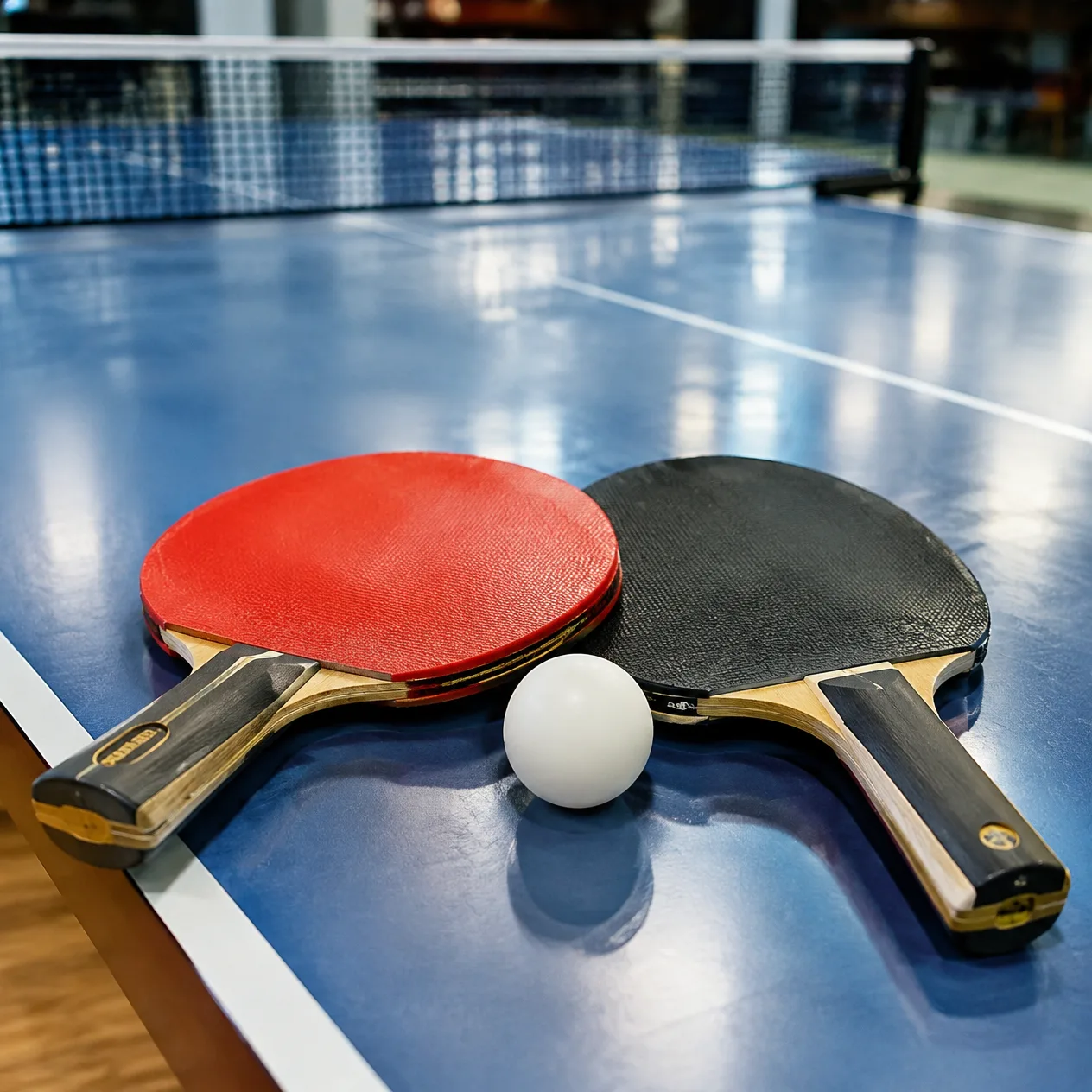
A photograph of two rackets lying face-up also does not show both sides of either one. Our illustration introduces the equipment; it is not evidence that a particular assembled racket satisfies the rule. No current product-list entry has been verified by this guide.
For a different label-reading problem, our badminton U and G guide separates weight and grip codes. For the game itself, our table-tennis scoring guide explains points and service turns. Neither substitutes for checking a racket covering.
Practical takeaway
Keep the black-side requirement, the expanded colour choices and equipment authorisation separate. Read both faces, record the exact covering and use the applicable competition rules. An unfamiliar colour is a prompt to check the facts, not a verdict about legality or performance.
Sources
- ITTF Statutes 2026 — racket laws, International Table Tennis Federation
- New racket-covering colours from 1 October 2021, International Table Tennis Federation
- Rules of Table Tennis — Equipment Basics, USA Table Tennis
Continue reading
Related articles
Classic Lined Crocs: can you remove the liner?
Check the Classic Lined Clog's fixed liner, match care guidance to the exact model, and avoid confusing a pivoting heel strap with a removable lining.

Wash-label numbers and bars: temperature is only half the check
Read the temperature number and bars under a wash tub separately, compare three fictional labels, and check the machine manual before choosing a programme.

Water-resistant zippers: AquaGuard and AQUASEAL labels
Read water-resistant and waterproof zipper claims separately. Compare AquaGuard and AQUASEAL names, identify the exact closure and check the finished product.