
Are the tramlines in? Tennis singles, doubles and serves
Learn when tennis tramlines count, why doubles serves use the same boxes as singles, and how to judge a bounce on a boundary line with three examples.
On this page
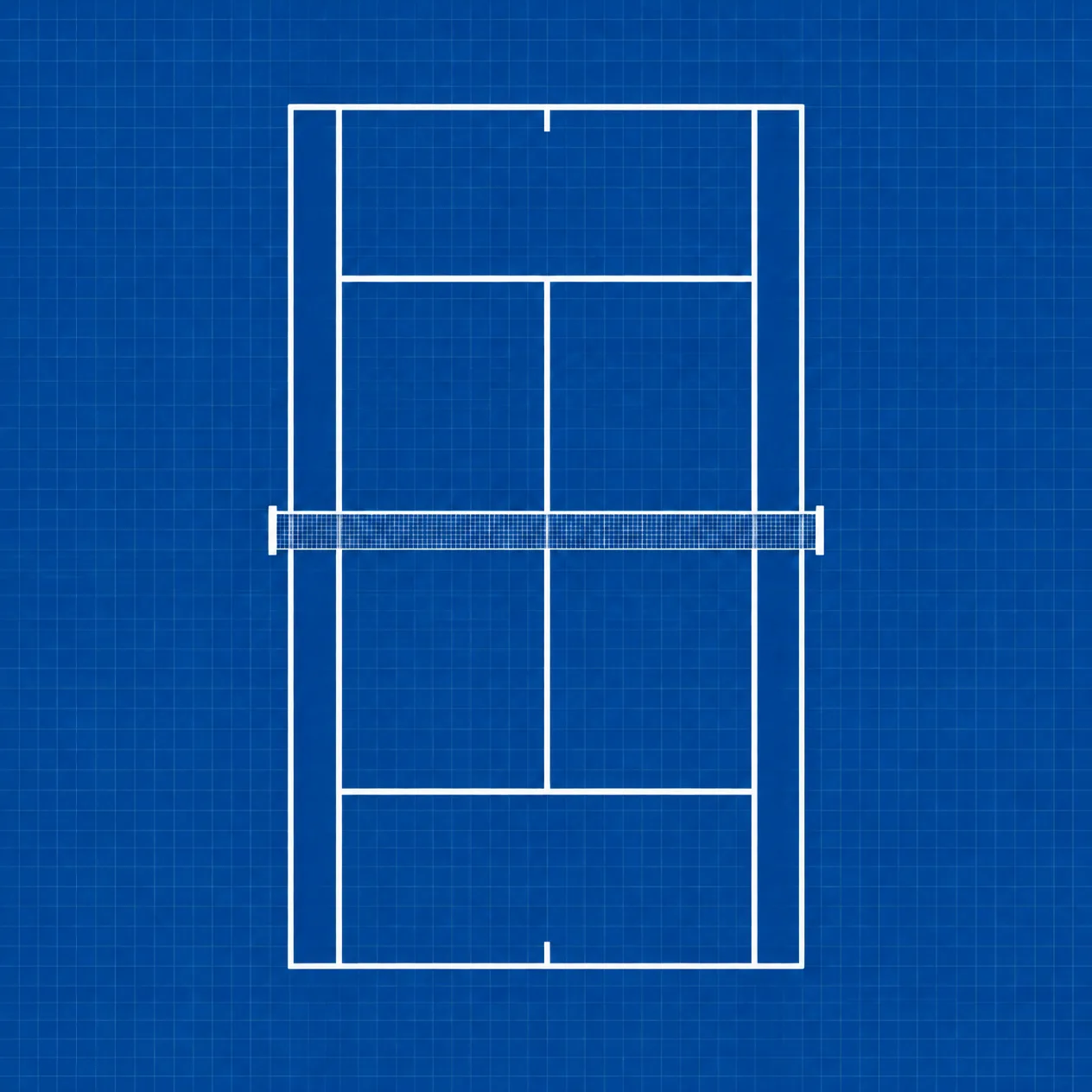
In full-size tennis, the doubles alleys count during a doubles rally, but they do not make the service boxes wider. In singles, the alleys are outside the landing area throughout the point. These long strips between the inner and outer sidelines are also called tramlines.
The useful question is not simply “did it touch a line?” It is “which area was the ball supposed to land in?” A line belonging to one area can sit well outside another. Separating the rally boundary from the service target makes the court much easier to read.
Find the rectangles before you play
Start at the baseline, the back edge of the court. Looking towards the net, find the two sidelines on each side. The inner pair encloses the singles court; the outer pair encloses the wider doubles court. The ITF tennis glossary explains these names and the doubles alleys between them.
Next, find the service line on each side of the net. Each service line joins the singles sidelines, rather than the outer doubles sidelines. The centre service line runs from the net to that service line, dividing the space into two service boxes. It does not continue through the backcourt to the baseline.
Do not confuse that centre service line with the small centre mark on the baseline. One divides the receiving boxes; the other helps identify the halves from which players serve.
The serve has its own target
The WTA court explainer describes service boxes extending from the net to the service line. For a particular serve, the target is just the diagonally opposite box. Its side edges are the centre service line and the relevant singles sideline.
The LTA rules overview also describes diagonal serving and distinguishes the singles and doubles sidelines. Adding a partner changes the rally width, not the service-box layout. Think of the serve as having a smaller landing target within the court used for the subsequent rally.
| Situation | Correct landing area | Are the alleys included? |
|---|---|---|
| Singles rally | Between the singles sidelines, as far back as the baseline | No |
| Doubles rally | Between the doubles sidelines, as far back as the baseline | Yes |
| Serve in either format | The diagonally opposite service box, including its boundary lines | No |
Once the serve has been returned, the service line is no longer the back limit for a shot. A rally ball can land beyond it and still be in, provided its first bounce stays within the appropriate sidelines and baseline. The painted boxes remain visible, but their service function does not restrict the rally.
Try three landing examples
These hypothetical examples concern the ball's first bounce, assuming it has reached the opponent's side in an otherwise valid exchange. Where it rolls afterwards does not change that landing.
- Touching the inner sideline during a singles rally: in. That line belongs to the singles court.
- Landing wholly inside an alley, beyond the service line but before the baseline: in during a doubles rally, but out during a singles rally.
- A doubles serve touching the outer doubles sideline: out of the service box. Playing doubles does not turn that line into a service boundary.
Rule 12 of the 2026 ITF Rules of Tennis assigns a line to the court it bounds; Rule 17 specifies the diagonal service court. These landing checks do not establish that every other rule was satisfied, such as the server avoiding a foot fault.
Practical takeaway
Before the first point, trace the appropriate rally rectangle with your eyes, then point to the service box for the next serve. Agree whether you are playing singles or doubles before resolving a disputed alley bounce.
For a different question about who serves next, use our tiebreak serving-order guide. If the confusion is on the scoreboard instead of the court, our tennis score notation guide explains the numbers.
Sources
- ITF tennis glossary — the court, International Tennis Federation
- Tennis explained: Learn the game, Women's Tennis Association
- Tennis rules and scoring, Lawn Tennis Association
- 2026 Rules of Tennis — Rules 1, 12 and 17, International Tennis Federation
Continue reading
Related articles
Swimming split times: totals versus each interval
Read cumulative and interval swimming splits with a fictional 200 m table. Check minutes and hundredths, missing checkpoints and result status separately.
Table-tennis doubles: who serves, receives and hits next?
Follow a four-player table-tennis doubles example: serving turns, alternating hits, the next game’s receiver and the deciding-game change at five points.

Pickleball doubles score: why games start at 0–0–2
Learn what the three numbers in a pickleball doubles score mean, why play starts at 0–0–2, and how the call changes after a point, server change or side out.