Knit or woven? Read the fabric construction
Tell knitted and woven construction apart using yarn and loop clues, understand why stretch is inconclusive, and ask for the right details when shopping.
On this page
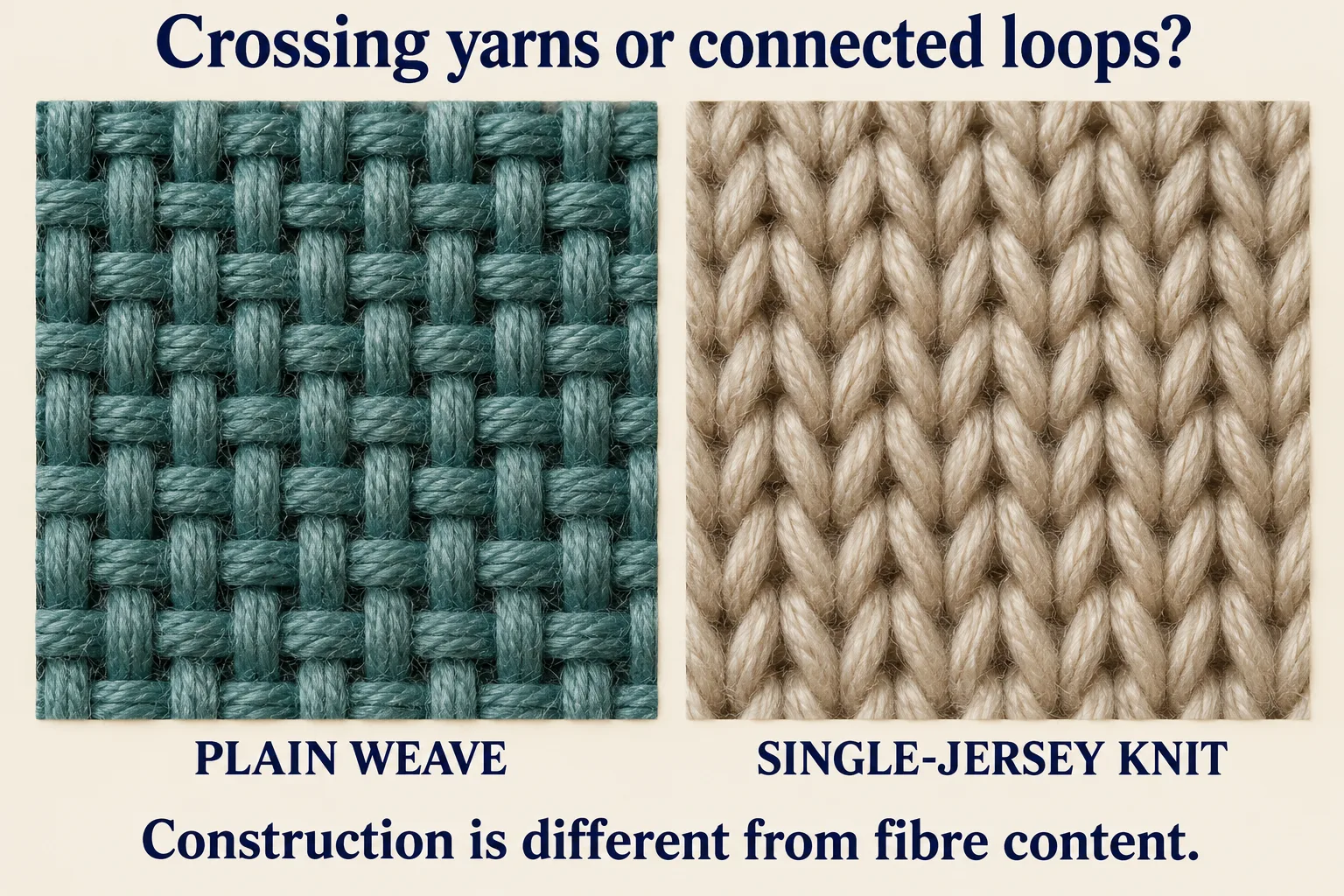
Two tops can both be described as cotton while having very different-looking surfaces. One may show an orderly crossing of threads; another may show tiny repeated stitches. The fibre name does not explain that difference. Knitting and weaving describe how yarns form a fabric, rather than what those yarns are made from. Learning to separate those questions makes product descriptions easier to read and helps you ask for a useful close-up when an online listing is vague.
Start with two separate questions
Ask first, “What is the fibre?” Then ask, “How is the fabric constructed?” The National Cotton Council’s manufacturing explanation describes both woven and knitted cotton goods. Cotton therefore does not, by itself, identify either construction. A knitted fabric is not necessarily wool, and “knit” does not mean that somebody made the garment by hand.
Keep the named part of a garment attached to its description. A statement about the main body does not establish how a cuff, lining or separate panel is constructed. Our fabric-percentage guide explains why composition statements for different sections should also remain separate.
In a woven fabric, follow the crossing yarns
CottonWorks’ weaving guide identifies two yarn directions: warp runs along the fabric length and weft across its width. Weaving interlaces these sets. In a simple plain weave, a weft yarn passes over one warp yarn and under the next, with adjacent rows alternating the arrangement.
Plain weave is an introductory example, not a description of every woven surface. Twill and satin are other basic weave designs. A visible diagonal pattern does not automatically mean that the fabric is knitted. Likewise, a printed check is a colour pattern; it does not prove that the visible squares are the underlying yarn structure. Look at the threads themselves when the detail is clear enough.
In a knit, look for connected loops
CottonWorks’ knit explanation describes intermeshing loops. In single jersey, the front commonly shows the legs of the stitches as repeated V shapes, while the reverse shows more of their rounded crowns. Looking at both sides can therefore be more informative than judging one distant photograph.
Rows of knitted loops are called courses; columns are called wales. These terms describe the loop arrangement, not two crossing sets of straight yarns. Knitting includes different structures and manufacturing methods, so do not require every knit to resemble a hand-knitted sweater. A smooth-looking surface in a small photograph may simply lack enough detail to identify confidently.
| Type | Look for | Avoid assuming |
|---|---|---|
| Woven | Interlaced warp and weft yarns. | Every weave is a visible square grid. |
| Knitted | Intermeshed loops or recognisable stitch rows. | Every knit has an obvious sweater texture. |
Why a pull test cannot settle the question
Stretch alone is an unreliable shortcut. Cotton Incorporated describes a mechanical-stretch woven cotton construction that uses no synthetic fibres. That is a concrete counterexample to the idea that a woven fabric cannot stretch, or that stretch always proves an elastane blend.
The example does not establish how much your particular item will extend or recover. Nor does a knit label supply a numerical stretch rating. Do not pull a garment hard to classify it, especially one you do not own. A gentle impression of movement is not a controlled material test, and it should not replace a clear construction description from the seller.
Read the listing before testing the garment
Search the product details for an explicit construction term, then compare it with the close-up. Keep those two observations distinct: “seller describes single jersey” is stronger than “the photograph looks smooth”. If the image is too small, ask for a close view of the main fabric’s front and reverse, or ask directly whether that section is knitted or woven.
There is no need to cut an edge, remove a seam or pull out yarns. If the available information is inconclusive, leave the construction unknown. The fabric’s denier or GSM answers another question and cannot fill that gap. Keep care instructions and the item’s intended use alongside the construction information rather than choosing a washing method or activity solely from the category name.
Practical takeaway
Identify the fibre, the garment section and the construction separately. Crossing yarns and connected loops are useful clues, but photographs and stretch impressions have limits. Use a clear description or a better close-up to resolve uncertainty. The result is a more informed clothing comparison, not a claim that one construction is always better.
Sources
- Fabric Manufacturing — woven and knitted cotton, National Cotton Council
- Weaving Basics — yarn directions and weave designs, Cotton Incorporated / CottonWorks
- Knit Basics — loops, courses, wales and jersey faces, Cotton Incorporated / CottonWorks
- NATURAL STRETCH Technology — mechanical stretch in woven cotton, Cotton Incorporated / CottonWorks
Continue reading
Related articles
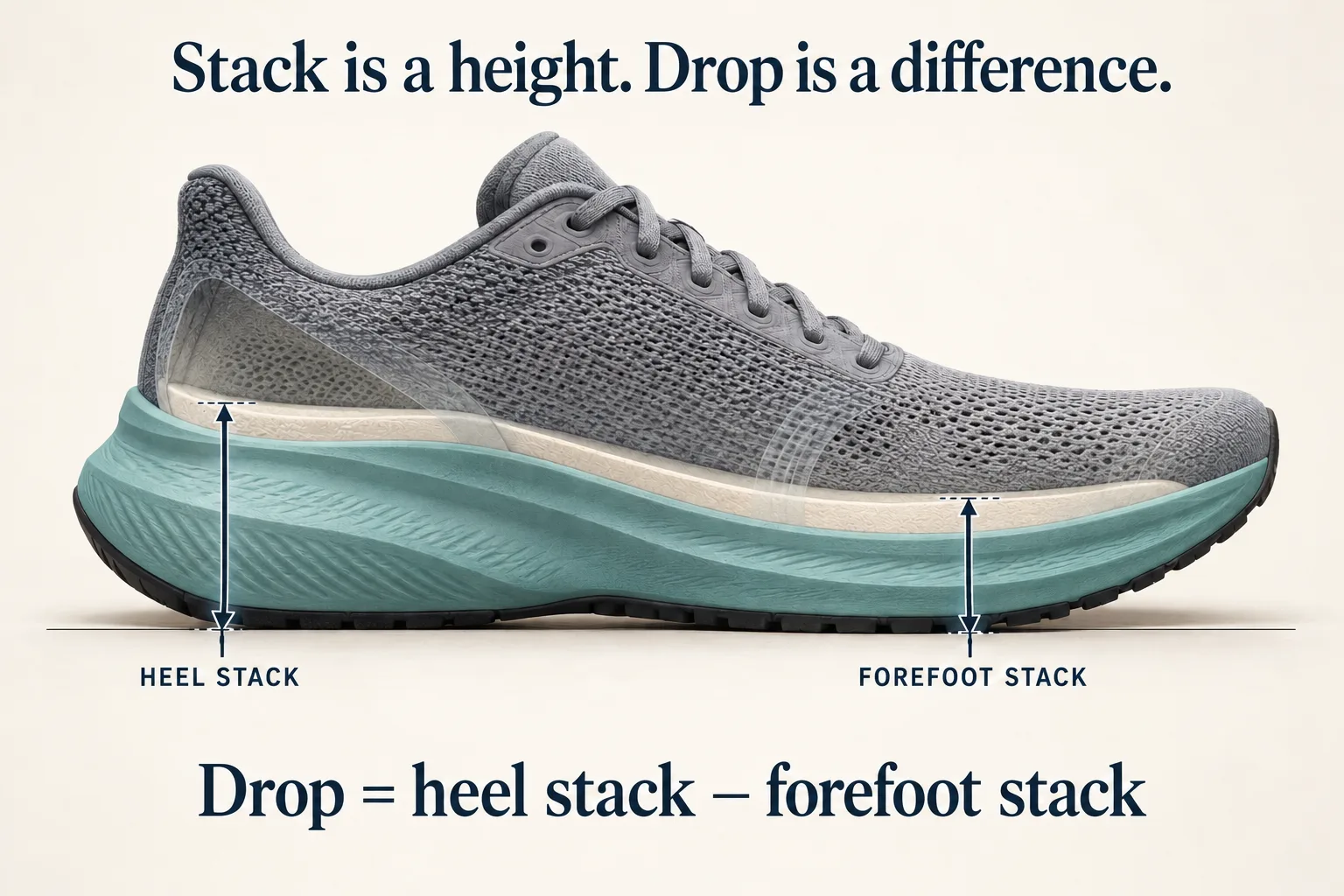
Stack height and heel-to-toe drop: read shoe specs
Compare shoe stack height and heel-to-toe drop using named manufacturer figures, a zero-drop example and a practical check for missing measurement labels.
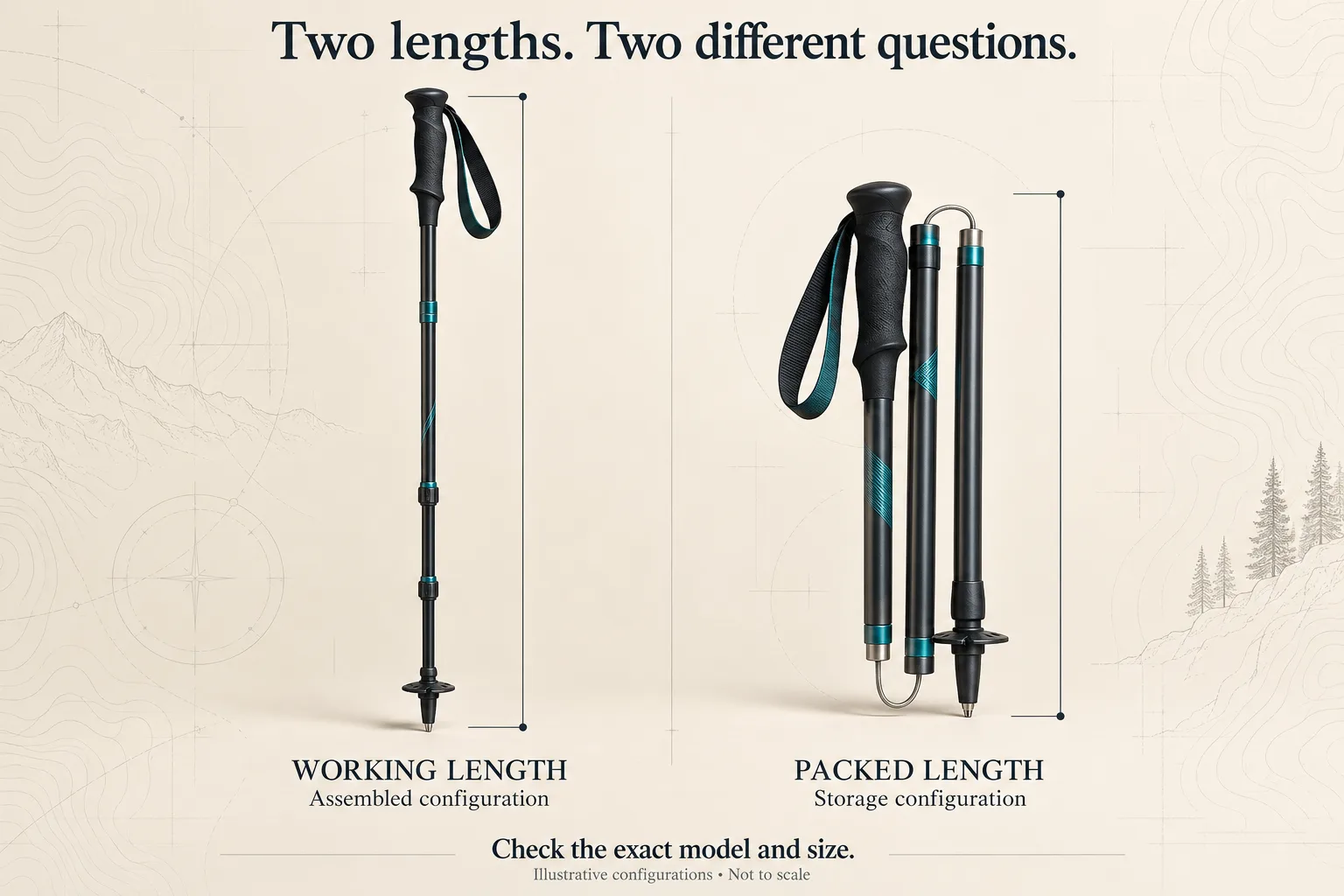
Trekking-pole length: working range versus packed size
Read trekking-pole working ranges and packed lengths correctly. Distinguish fixed, adjustable and folding designs, then check the exact size and bag fit.
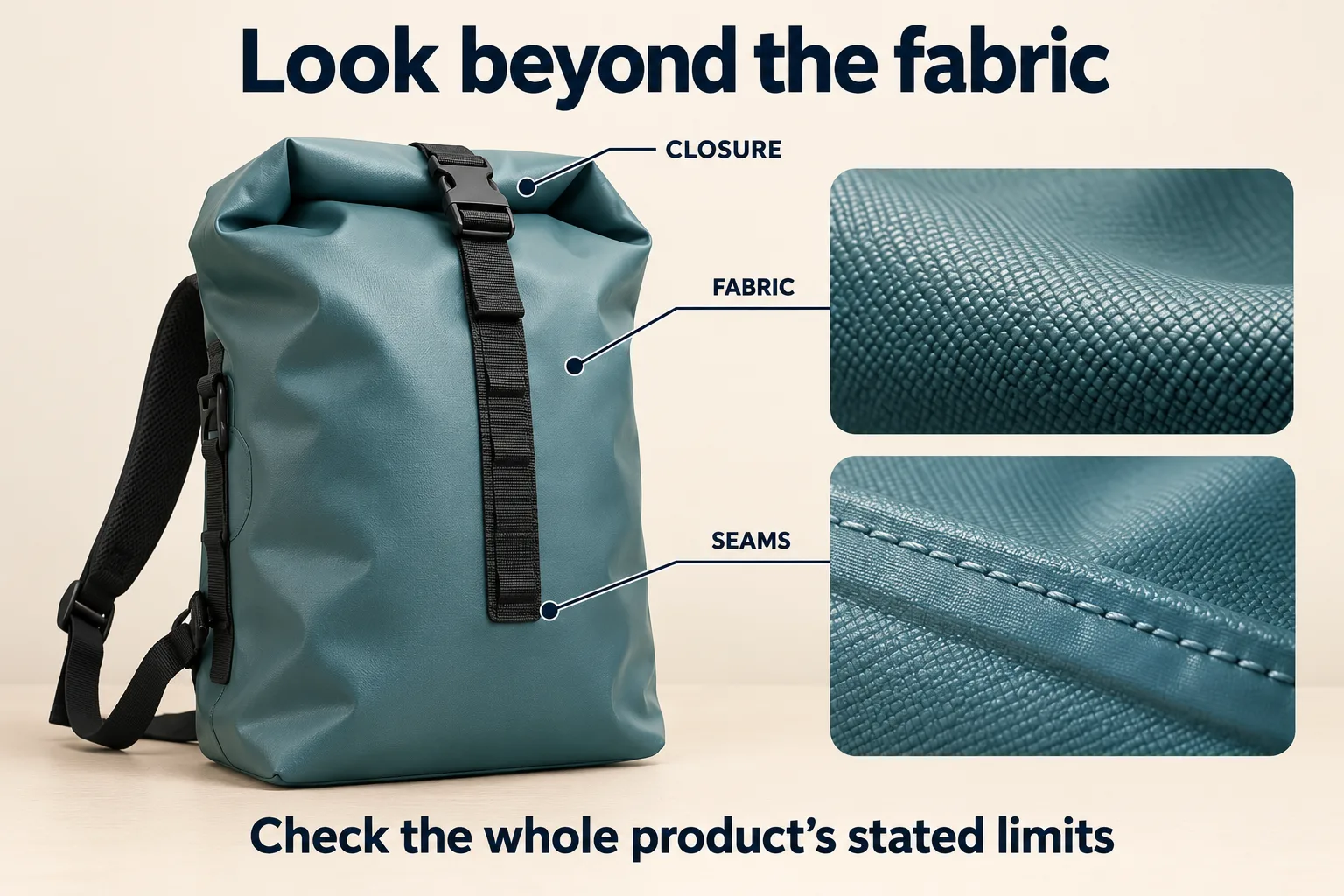
Waterproof bag claims: fabric, closures and IP ratings
Separate waterproof fabric from whole-bag protection. Read IP64 and IP67 examples, closure conditions and the limits to check before packing your belongings.